On this page
An expression on a thumbnail is a claim about the size and direction of what happens in the video, so the right one is chosen by the outcome, not by which face looks most dramatic. Face Lab produces eight expressions from one selfie (Shocked, Surprised, Happy, Excited, Angry, Curious, Scream and Sad), and they are not eight equal options. They sit on three ladders, each rung making a bigger or a different claim than the one below it, and the most common mistake is picking the right ladder and climbing one rung too high.
The eight faces sit on three ladders
This is our framing rather than anything measured, but it has held up across the covers we look at. Four of the eight expressions are one emotion at rising intensity: Curious, Surprised, Shocked, Scream. Two are a positive emotion at two intensities: Happy, Excited. The last two are negatives that differ in where they point: Angry says someone is at fault, Sad says nobody is. Seen this way, choosing an expression becomes two decisions: which ladder, then which rung.
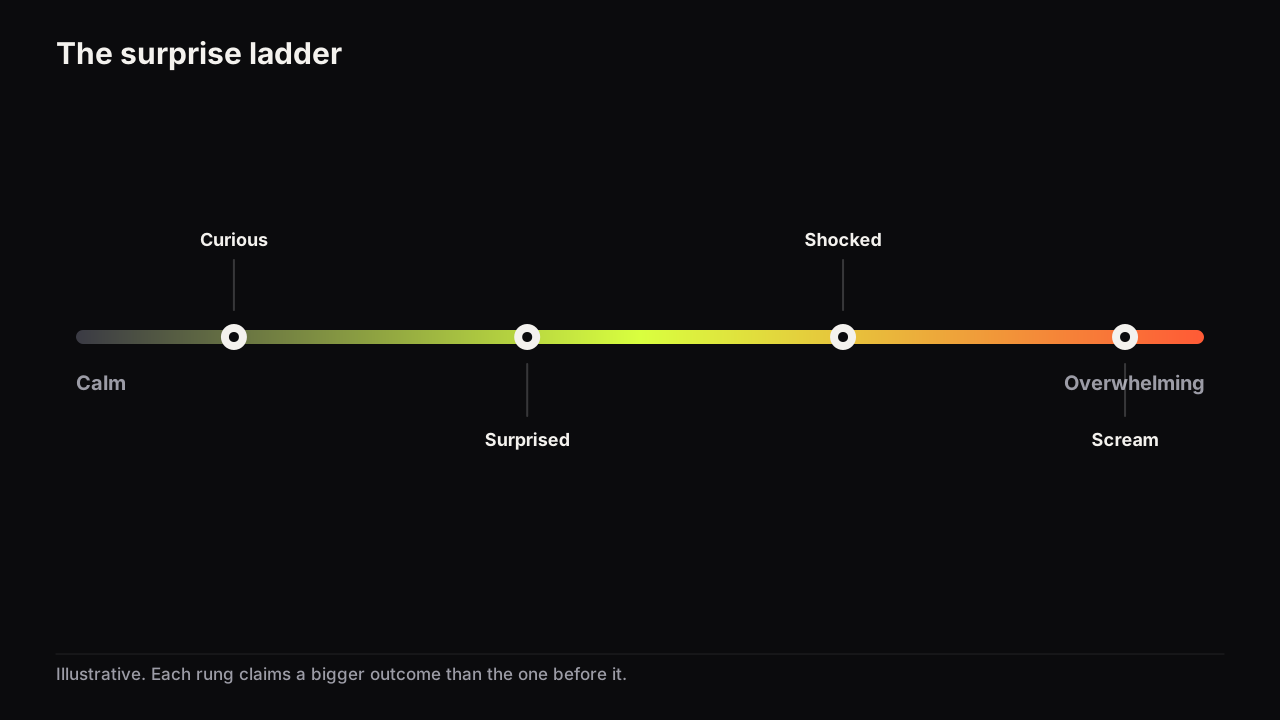
The rung matters because the viewer reads it as the size of the outcome. A Shocked face promises something big; if the video's twist is modest, the viewer who clicked for big leaves early, and YouTube's help page on A/B testing titles and thumbnails says a test's result is decided by watch time share, not clicks. Promise alignment for AI covers in general is covered by the guide to how generators work and where they fail; here the practical rule is to pick the rung that matches the outcome and, when unsure, the rung below.
What each face says
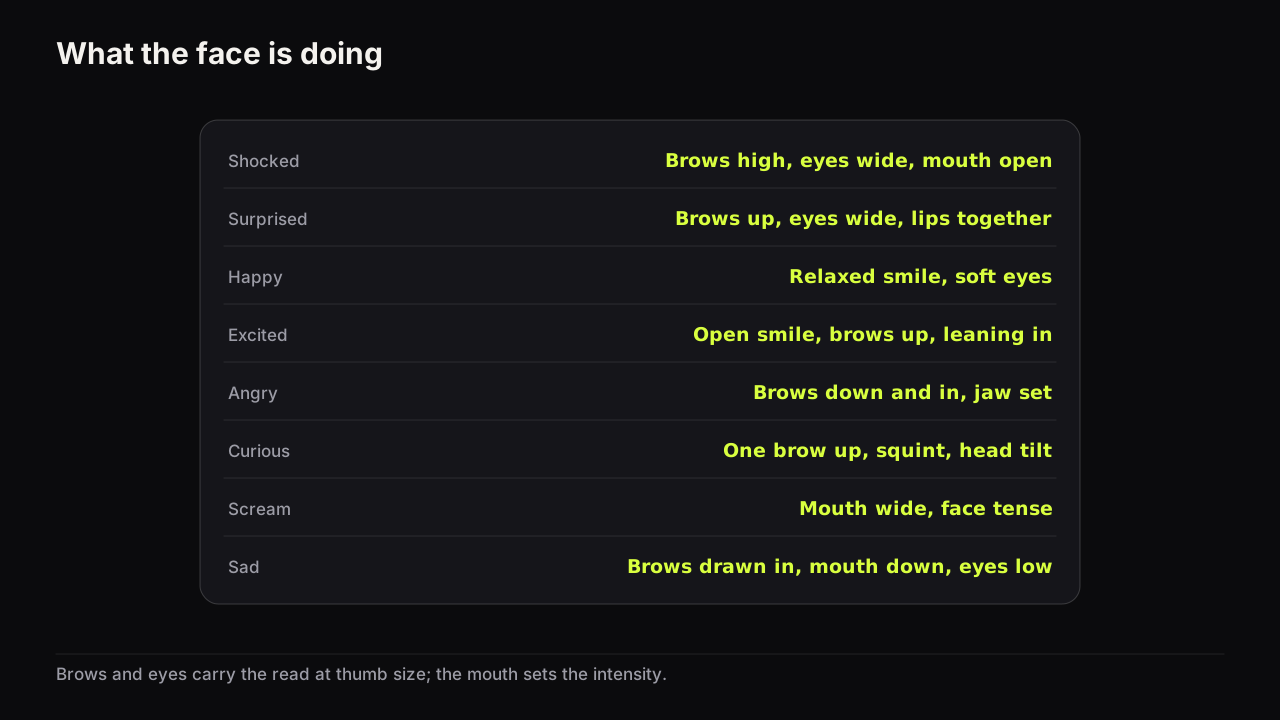
The table describes what each expression does physically, because that is what a viewer reads at thumb size, and what claim it makes about the video.
| Expression | What the face does | What the viewer reads | Fits |
|---|---|---|---|
| Shocked | Brows high, eyes wide, mouth open | Something big and unexpected happened | Reveals, results, fails, big numbers |
| Surprised | Brows up, eyes wide, mouth closed or barely open | I did not expect this | Discoveries, small twists, comparisons, tests |
| Happy | Relaxed smile, soft eyes | This went well and I like it | Tutorials, positive reviews, day-in-the-life |
| Excited | Open smile, brows up, visible energy | I cannot wait to show you this | Unboxings, launches, wins, announcements |
| Angry | Brows down and in, mouth tight or shouting | Someone did something wrong | Warnings, rants, exposés, complaints |
| Curious | One brow up, slight squint, head tilted | Is that true? | Questions, myths, tests, finance and education |
| Scream | Mouth wide, face tense, eyes wide or shut | Overwhelming | Gaming, horror, extreme challenges |
| Sad | Brows drawn in, mouth down, eyes lowered | I lost something | Confessions, failures, goodbyes, mistakes |
The general question of which emotion fits which promise, and why the face is read before anything else, belongs to the guide to facial expressions on covers. This piece assumes that and goes one level down, to the specific eight.
The pairs creators confuse
Most expression mistakes are not a wrong ladder but a wrong rung, and four pairs account for nearly all of them.
| Pair | The tell | Choose the first when | Choose the second when |
|---|---|---|---|
| Surprised vs Shocked | The mouth: closed or barely open against wide open | The twist is real but modest, or the audience distrusts drama | The outcome is large and the niche accepts energy |
| Happy vs Excited | State against anticipation: a settled smile against an open one | The video is the pleasant thing itself | The video is about the thing that is coming |
| Curious vs Surprised | Before against after: a question against an answer | The video asks and tests | The video found something |
| Angry vs Scream | Direction against volume: pointed at someone against pointed at nothing | There is a culprit in the video | There is only intensity |
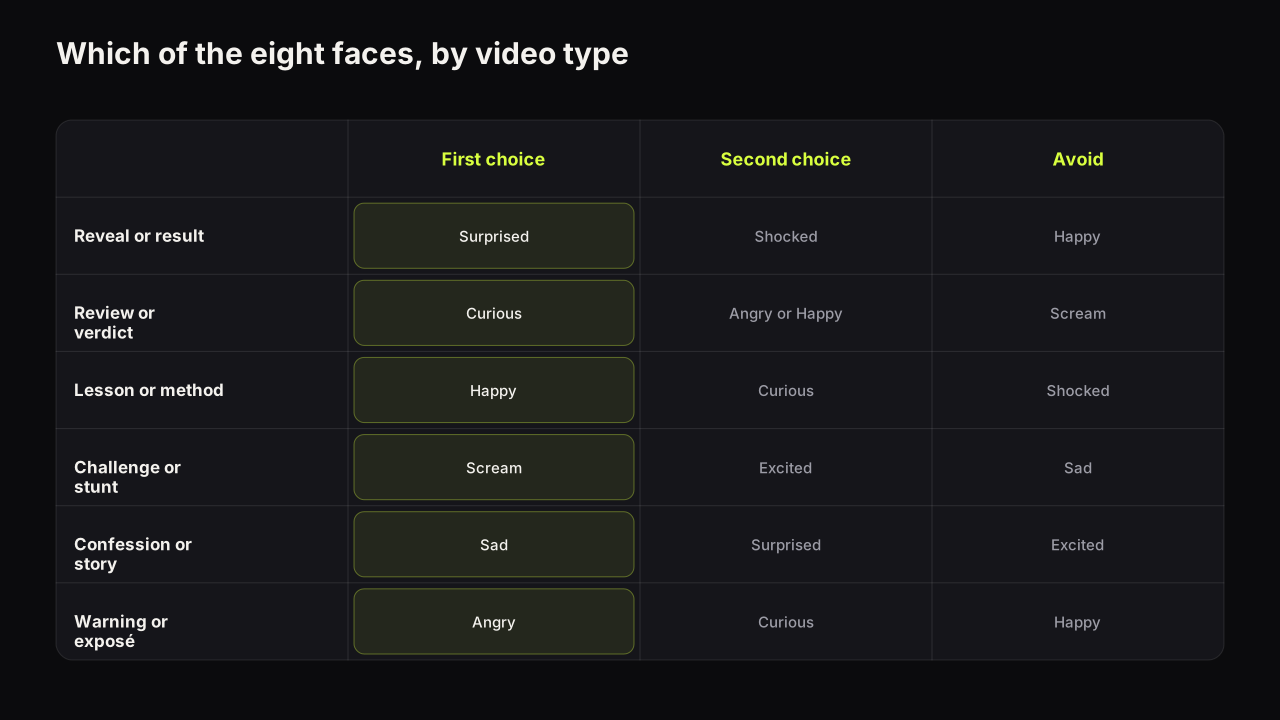
Surprised is the most under-used face in the set. Creators reach for Shocked because it is louder, and in finance, education and reviews the louder face reads as hype to exactly the viewers who were going to click. The closed-mouth version carries the same "I did not expect this" with credibility intact, which is why it appears in the first-choice column for more video types than any other expression in the hero figure.
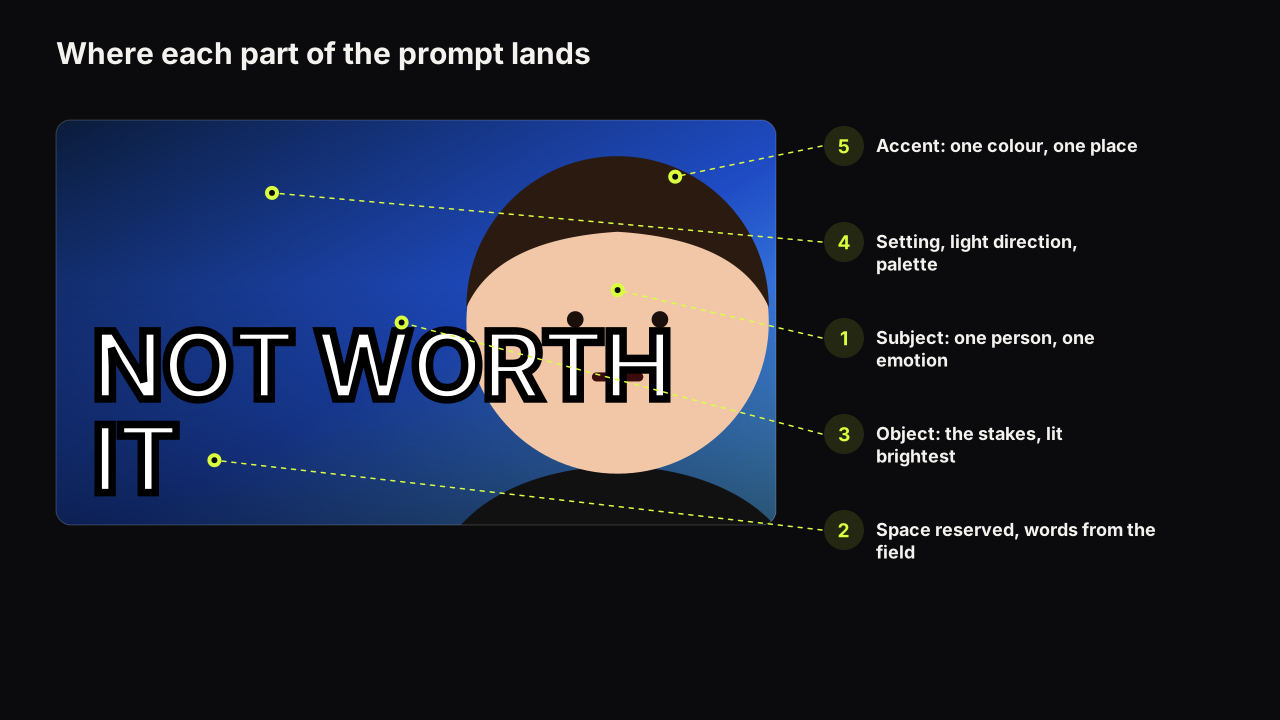
Take a cover for a video where a £30 charity-shop lamp turns out to be worth £400. The instinct is Scream: mouth wide, hands on the head, the lamp small in a corner, INSANE FIND in red. The viewer infers a stunt channel and discounts the number before reading it. One rung down is Surprised: lips together, eyes wide, the lamp large and lit at its edge, the face turned toward it, £400? as the only words. Same outcome. The face now looks like someone who was not expecting it rather than someone paid to react.
We would render Surprised over Shocked on any reveal that is not a stunt, even though the Shocked version will sometimes win the first glance. The click it wins is the one that leaves early, and the test resolves on watch time share, not on the glance.
Choosing by video type
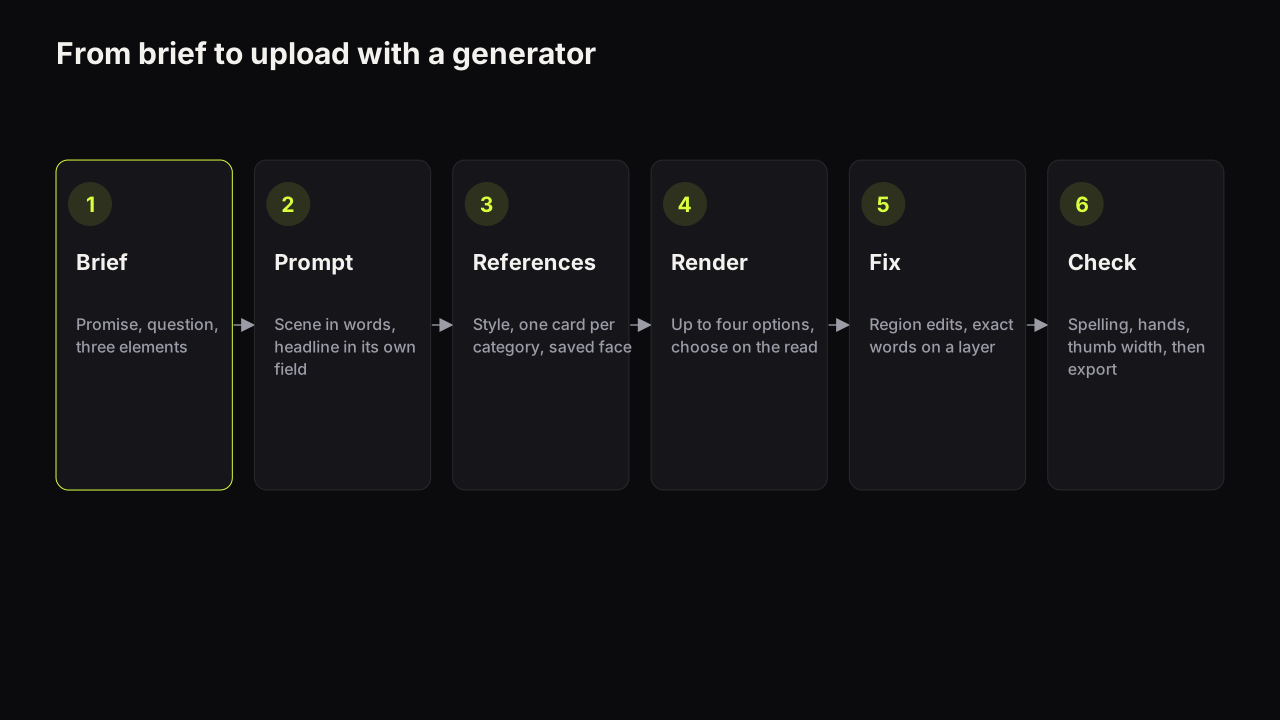
Work from the outcome. Name what the video delivers in one sentence, decide whether that is a question, an answer, a win, a loss or a wrong, then pick the ladder and the rung.
| The video is | First choice | Second choice | Avoid |
|---|---|---|---|
| A reveal or a result | Surprised | Shocked | Happy (it answers the question) |
| A review or a verdict | Curious | Angry if the verdict is bad, Happy if good | Scream |
| A lesson or a method | Happy | Curious | Shocked |
| A challenge or a stunt | Scream | Excited | Sad |
| A confession or a story | Sad | Surprised | Excited |
| A warning or an exposé | Angry | Curious | Happy |
| A versus or a comparison | Curious | Surprised | Scream |
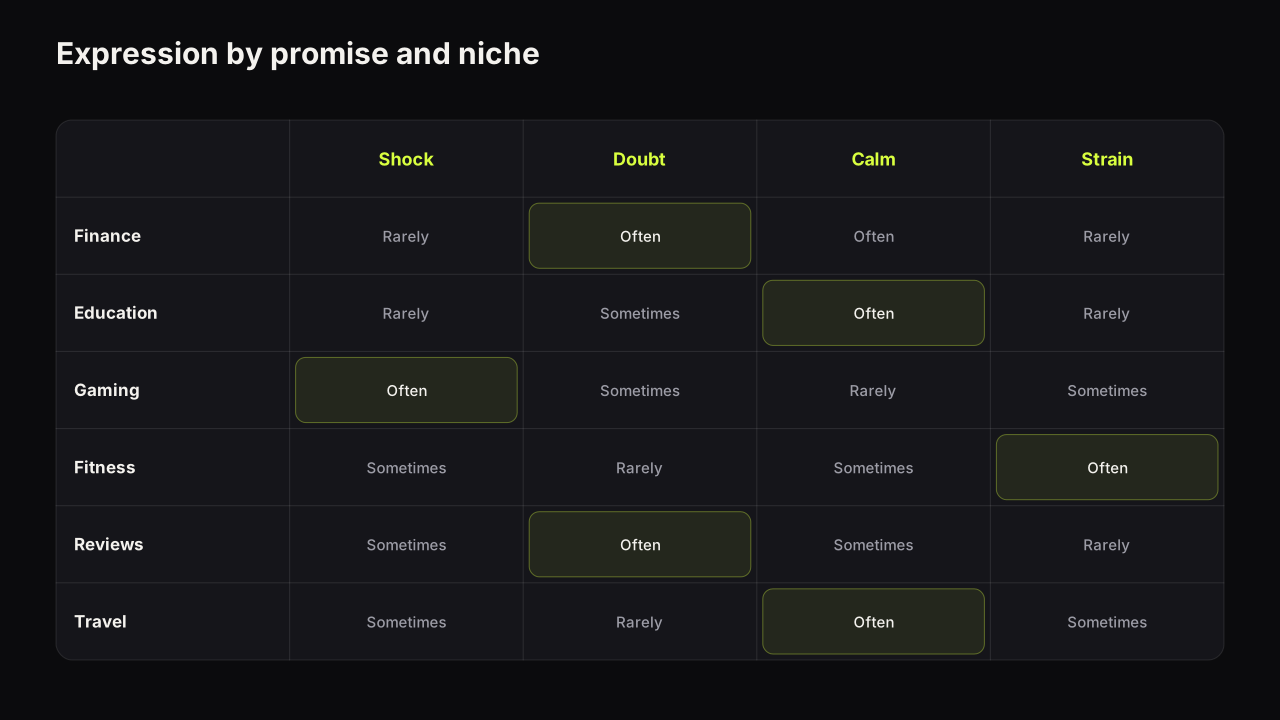
Two niche notes, both observed patterns: finance audiences tend to trust Curious and Surprised and read Shocked as a sales pitch, which is the reasoning behind the doubt-led finance cover; education audiences tend to reward Happy and Curious because both signal "this is manageable", the case made in the calm educational cover.
Where the eyes go
The expression sets the claim; the gaze sets the eye path. Surprised and Curious work best looking at the object, because they invite the viewer to look at what caused them. Angry and Sad work best looking at the viewer, because they are addressed to someone. Shocked and Scream can do either, and Happy and Excited looking at the viewer read as an invitation. The mechanics of gaze, and when eye contact reads as sales, are the subject of eye direction and gaze in thumbnails. The rule to remember here is that the face should be looking at whatever it is reacting to, and that thing should be in the frame or in the headline.
Describing an expression in a prompt
When the cover has no saved face, the expression has to be written into the scene prompt, and the single emotion word is the weakest way to do it. "Surprised" gives the model a wide target. The mechanical description gives it a narrow one.
| Expression | Prompt wording that lands |
|---|---|
| Shocked | eyebrows raised high, eyes wide open, mouth open, leaning back slightly |
| Surprised | eyebrows raised, eyes wide, lips together, head still |
| Happy | relaxed genuine smile, eyes slightly narrowed, shoulders down |
| Excited | wide open smile, eyebrows up, leaning toward the camera |
| Angry | eyebrows pulled down and together, jaw set, lips pressed or mouth shouting |
| Curious | one eyebrow raised, slight squint, head tilted, mouth closed |
| Scream | mouth wide open, face tense, eyes wide, neck strained |
| Sad | eyebrows drawn in and up at the centre, corners of the mouth down, eyes lowered |
Write one expression per prompt and describe brows, eyes and mouth in that order, because that is the order of importance at thumb size. With a saved face, choose the expression in Face Lab and keep the prompt about the scene; asking the prompt for a different emotion than the face you selected gives the model two instructions for the same region. The six-part prompt structure puts the emotion in part one for the same reason: it narrows everything after it.
Changing the expression on a finished cover
A render is often right in every way except the rung: the scene, the light, the headline and the composition all work, and the face is Shocked where the outcome was Surprised. Rendering again risks all of it. On the bench you can change the expression on a finished result instead, which returns two options for two credits and leaves the rest of the picture alone.
That is also the cleanest one-variable change for a test. Two covers that differ only in expression, Curious against Surprised on the same scene and headline, ask one question of the audience, which is the discipline set out in designing test variants that resolve.
All eight expressions come from one selfie, so the quality of that photo decides the quality of every face after it; what makes a selfie work in Face Lab covers the framing, light and neutral base. And the face has to be one you may use: your own, or a co-host's or client's who agreed to be on your thumbnails. No public figures without consent, no minors, as the acceptable use policy sets out.
What to do next
Write the one-sentence outcome of your next video. Decide whether it is a question, an answer, a win, a loss or a wrong; that names the ladder. Then choose the rung one step below your first instinct and render two versions, the instinct and the step below, from the same scene. Judge them at thumb width beside the covers already in your niche's row, and keep a note of which rung this audience trusted, because that note is worth more than the credit it cost.