On this page
Test the title and thumbnail together when the question is which promise to make, and test one half alone when the promise is settled and you are refining how it is said. YouTube's tool allows both, and with three slots per video there is a third design that most creators never use: a control package plus one slot that changes only the title and one that changes only the cover, which tells you which half did the work. This article is about laying the three slots out so the result can be read.
YouTube's help page on testing titles and thumbnails says you can test up to three titles, thumbnails, or title and thumbnail combinations per video, that the result is decided by watch time share rather than clicks, and that when a test is inconclusive the first uploaded option becomes the default. The page describes the Preferred result state in the context of thumbnail-only tests.
The mechanics of running the tool, the manual swap and the meaning of each result state are in the A/B testing guide. What follows assumes those and adds the part specific to two moving parts.
Pair or half: what is in question
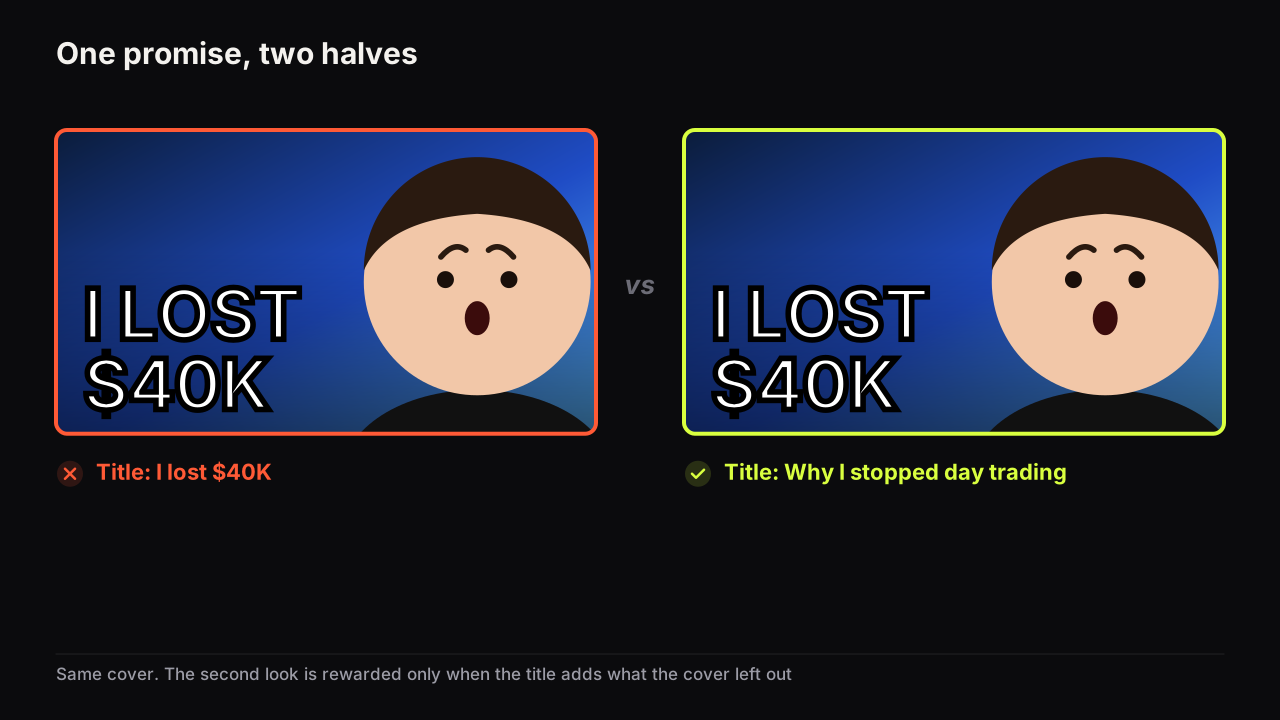
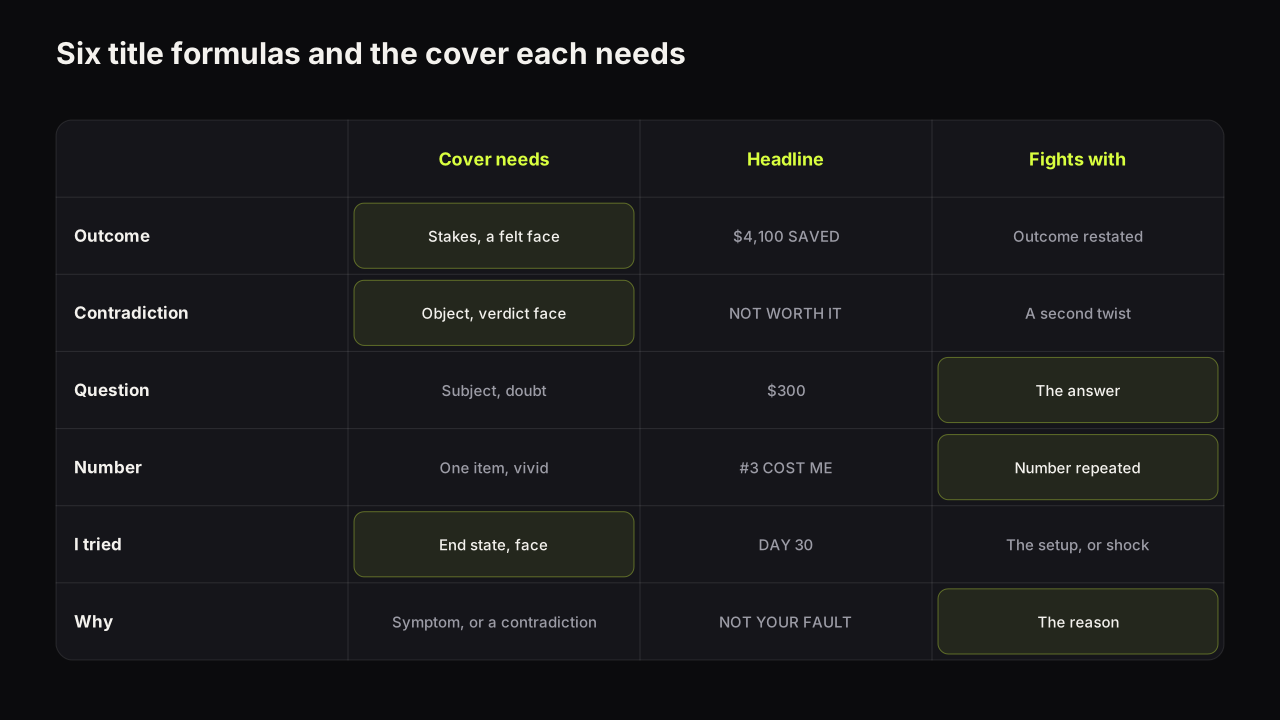
The viewer experiences one promise split across two places. The division of labour between title and cover is that one says what the video is and the other says why it matters, and the test design follows from which of those is uncertain.
| The question you are asking | Test | Why |
|---|---|---|
| Which promise should this video make? | Two complete packages | The promise lives in both halves; changing one half leaves the other making the old promise |
| The promise is right; does the cover need the number? | Thumbnail half, title fixed | Only the cover's lever is in doubt |
| The promise is right; does the title need the "why"? | Title half, cover fixed | Only the title's wording is in doubt |
| I do not know which half is weak | Wedge: control, title-only change, cover-only change | Each half is isolated against the same control |
| Most impressions come from search | Title half first | The title is read as text in a list of results; the cover is small beside it |
| Most impressions come from Browse or Suggested | Cover half first, or a pair | The cover is seen first and the title is read after, if at all |
The last two rows are what we observe rather than anything documented. YouTube's thumbnail and title tips page does note that viewers may only see part of the title, which is one reason a cover-first surface makes the title the second read; how title length interacts with that is its own question.
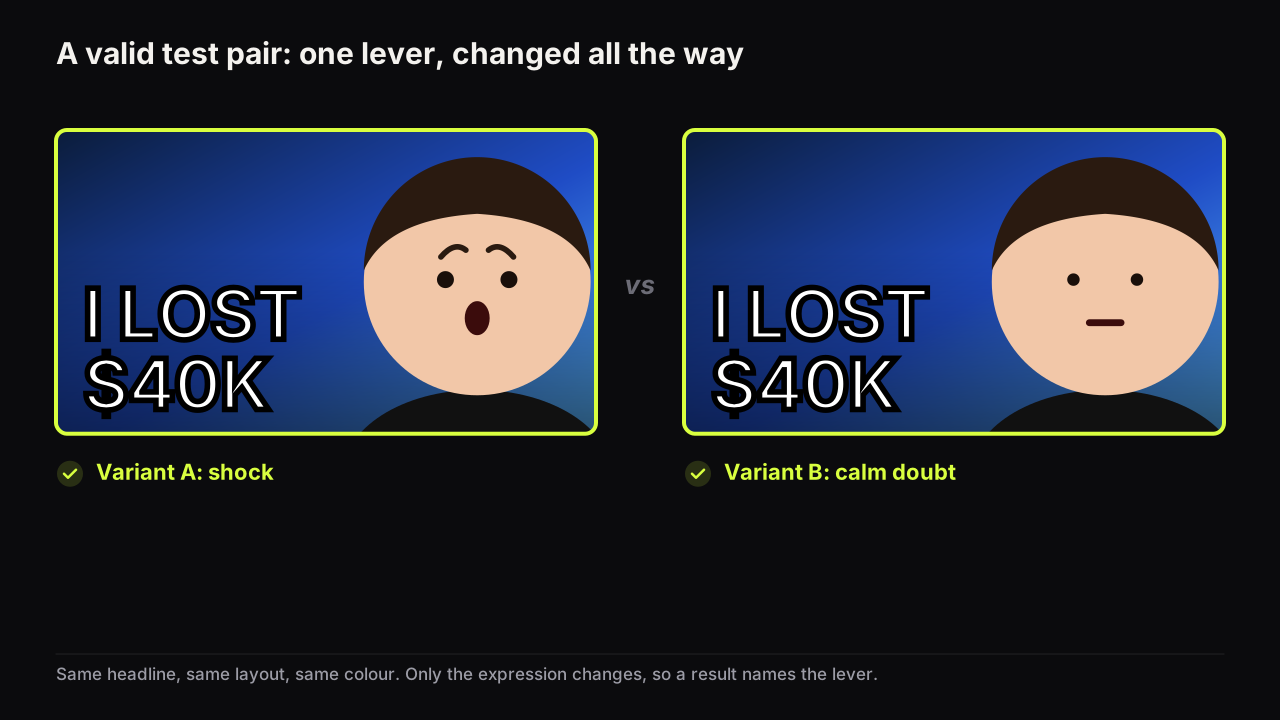
In practice the half test is over-used and the wedge is under-used. Creators change the cover, see a result, and credit the picture, when the title was carrying the promise the whole time and the cover only had to not contradict it. The wedge costs one extra slot and settles that question.
The three designs, slot by slot
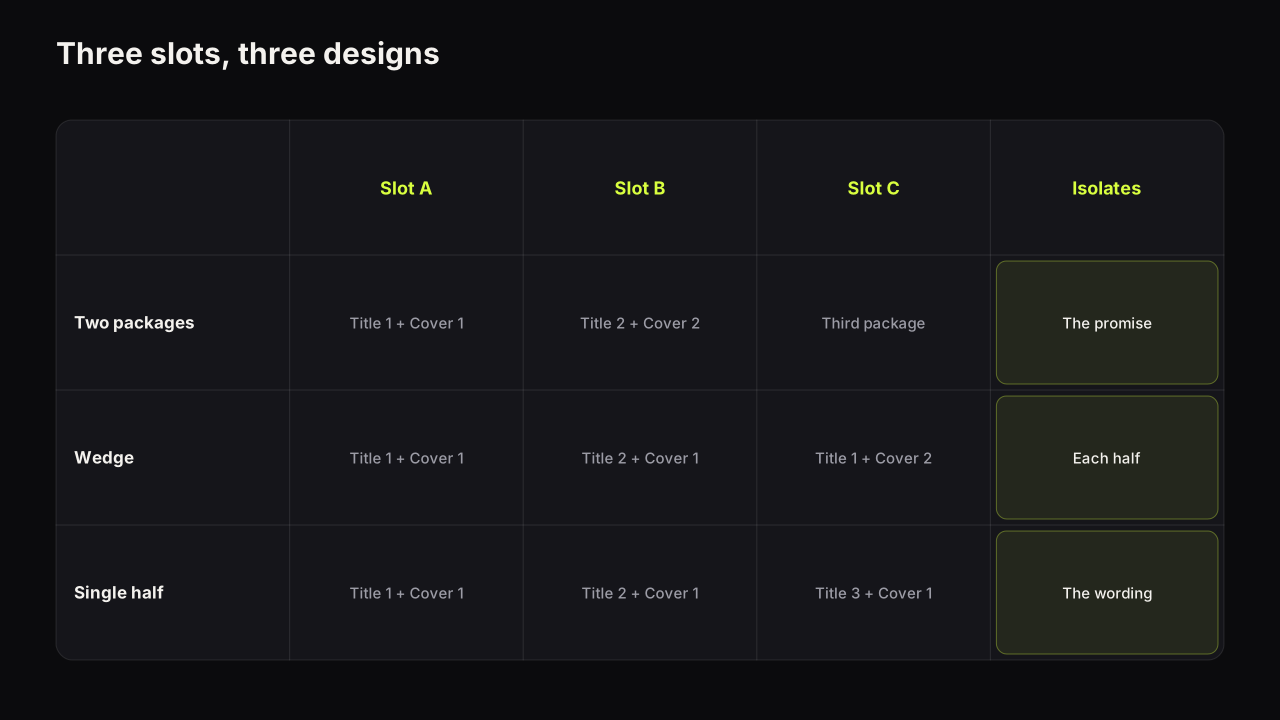
Three slots and two halves cannot give you every combination; a full grid of two titles and two covers needs four cells. Each design below spends the three slots differently, and each has something it cannot tell you. Choose by what you need to know, not by what looks thorough.
| Design | Slot A | Slot B | Slot C | Tells you | Cannot tell you |
|---|---|---|---|---|---|
| Two packages | Title 1 + Cover 1 | Title 2 + Cover 2 | A third package, or leave empty | Which promise this audience wanted | Which half made the difference |
| Wedge | Title 1 + Cover 1 | Title 2 + Cover 1 | Title 1 + Cover 2 | Which half moved the result against the control | How the two changes behave together |
| Single half | Title 1 + Cover 1 | Title 2 + Cover 1 | Title 3 + Cover 1 | Which of three wordings suits a fixed cover | Anything about the cover |
Two packages is the honest test of a promise. Package A leads with stakes in both halves; package B leads with method in both halves. Each is a coherent pair, so the winner is a whole promise you can ship and reuse. Its cost is that it teaches you nothing about which half to credit, which is fine when the goal is to ship the better package and unhelpful when the goal is a rule about covers.
The wedge is the design for learning. Slot A is the package you would ship today. Slot B keeps that cover and changes only the title. Slot C keeps that title and changes only the cover. Each of B and C is compared with A on its own, and the result names the half. Its blind spot is the missing fourth cell: you never see Title 2 with Cover 2, so if both halves help, their combination is a claim, not a result. Run it as the control of the next test.
Imagine a wedge on a woodworking video. Slot A: the title "I built a desk from one sheet of plywood", the cover the finished desk in a bright workshop, a proud face beside it, ONE SHEET in heavy white. Slot B keeps that cover and changes the title to "This desk cost me £61 in plywood". Slot C keeps A's title and swaps the cover for the raw sheet leaning against a wall, a doubtful face, the same ONE SHEET. If B goes ahead and C sits level, the price did the work and the desk photo was fine as it was. Ship B's title, and the next test refines the cover under it.
We would run the wedge as the default on any channel that uploads weekly, even though it spends the third slot on learning rather than on a third promise that might have won outright. A channel shipping fifty covers a year gets more from knowing which half moves its audience than from one extra winner it cannot explain.
The single half is a refinement design, three wordings against one cover or three covers against one title. It belongs in the same place on the ladder as any one-lever test, and how different the three need to be applies to titles as much as covers: three titles that differ in one word are twins.
Whatever the design, every slot has to be an honest pair on its own. A wedge's slot B puts a new title beside the old cover, and if the new title says what the cover's headline says, or asks a question the cover answers, slot B loses for a reason that has nothing to do with the title. Why a pairing fights itself covers the failure; the check before a wedge is to read each slot as a viewer would and confirm the two halves still split the job. Where a slot cannot be made honest, the design is wrong for this video, and two packages is the safer choice.
Reading a result where the title did the work
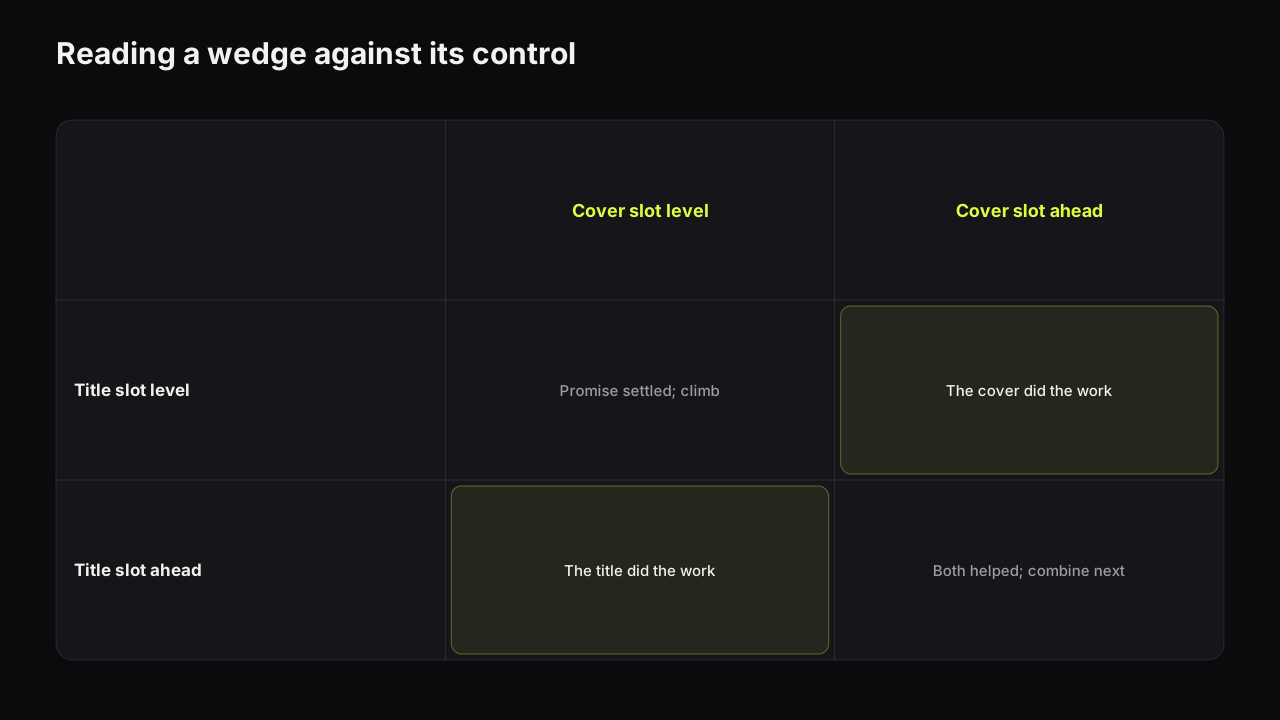
A wedge produces two comparisons, and the reading is a small grid. The result state for the whole test is YouTube's verdict on the three slots together; the attribution is yours, from how B and C each sat against A.
| Slot B (title changed) against A | Slot C (cover changed) against A | Reading | Next test |
|---|---|---|---|
| Ahead | Level | The title did the work | Ship title 2; refine the cover under it |
| Level | Ahead | The cover did the work | Ship cover 2; refine the title beside it |
| Ahead | Ahead | Each half helped on its own | Title 2 + Cover 2 as the new control against the old |
| Level | Level | This promise is settled at this level | Climb: two packages with a different promise |
| Ahead | Behind | The title helped and the cover hurt | Ship title 2 with cover 1; ask what cover 2 promised that the video did not deliver |
Two cautions on reading. First, "ahead" and "level" come from the result state and from watch time share, not from the CTR line; the explainer on watch time share sets out why a slot with more clicks can still sit level or behind. Second, a title changes who clicks and what they expect in a way a cover often does not, because it is the half that gets read. When slot B wins, the usual reason is not that the title was more attractive; it is that the title set a truer expectation, so the viewers it brought stayed. That is a lesson about the promise, and it should be logged as one.
When creators show us a wedge where the title won, the new title is almost always more specific than the old one: a number where there was an adjective, a named thing where there was a category. The cover had been specific already, and the old title was the half letting the package down.
With two packages, resist attribution entirely. "Package B won" is the result, and the lesson is about the promise ("the method promise beat the stakes promise on this format"), not about the cover. Crediting the cover for a package win is the most common false lesson we see in logs, and it sends the next five covers in a direction the test never supported.
Packaging as a unit in the brief and the log
If the test is of the pair, the pair has to exist before the test, which means the brief writes both halves of each package and the log records both. A log entry that reads "tested cover B, Winner" for a wedge whose winner was slot B has lost the information that made the test worth running. The decision log template has a variants field wide enough for "Title 2 + Cover 1 against Title 1 + Cover 1", and that is how a packaging test should be written down.
The brief's job is to keep each package coherent. For each slot, write the title and the headline on one line and check that the headline does not repeat the title; when the words on the cover should differ from the title is the rule. A package whose two halves say the same thing is spending a slot to test repetition.
- Each slot is an honest pair: the two halves split the promise and neither repeats the other.
- The design matches the question: pair for the promise, half for a wording, wedge for attribution.
- Slot A is the package you would ship today, because it becomes the default if the test is inconclusive.
- The log entry names both halves of every slot.
- The lesson is about the promise or the half, never "the cover won" after a package test.
Making the covers for two packages
The cover side of a package is the faster half to produce, and it should be, because a packaging test often needs three covers rather than one. On the bench the maker renders a cover from a scene description and the headline typed into the "Words on it" field, up to four options per render, so the two packages' covers can be made from two headlines against the same scene, or from two scenes where the promise differs. For a wedge, slot C's cover is a Tweak of slot A's: the finished render becomes the source, the headline or one scene element changes, and the rest holds. Titles are yours to write; the bench does not generate them.
Common questions
Can you test a title without changing the thumbnail?
Yes. YouTube's help page says Test & Compare accepts up to three titles, thumbnails, or title and thumbnail combinations per video, so a title-only test with the cover fixed is one of the three designs available. It is the right design when the cover is settled and the question is only how the title should say the promise.
Should the words on the thumbnail change when the title changes?
Only if the new title would otherwise repeat them. Title and headline split one promise between them, so a title that now says what the headline used to say leaves the cover repeating it. Check the pair for repetition before the test, not after.
Can a test tell you the title won when the pair was tested together?
Not if you tested two complete packages, because each slot changed both halves. It can if you used a wedge design, where slot B changes only the title and slot C changes only the cover against a shared control, and the result of B against A is read separately from C against A.
What to do next
- Decide which question the next test is asking: the promise, one half's wording, or which half is weak. Pick the design from that.
- Write every slot as a title and a headline on one line, and strike any slot where they repeat each other.
- Upload the package you would ship today as slot A.
- When the result arrives, read B and C against A separately if it was a wedge, and log the lesson about the promise or the half, with both halves of each slot named.