On this page
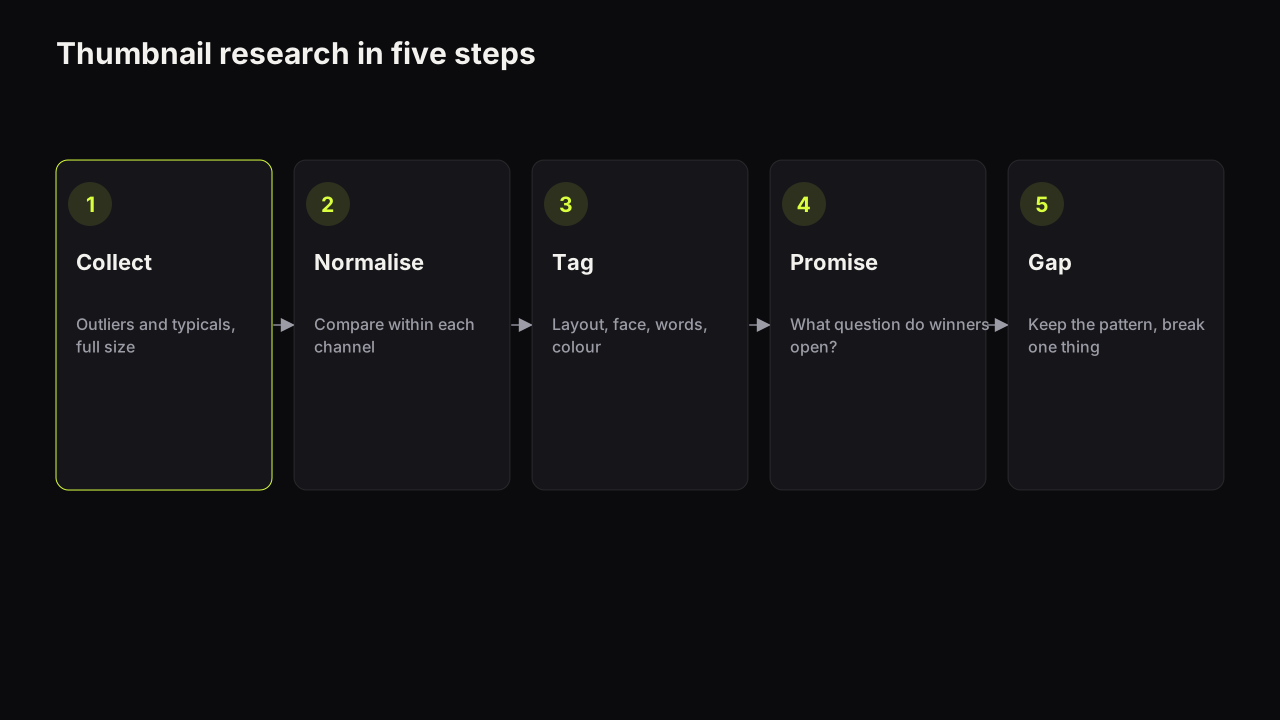
A thumbnail trend is a change in what the audience expects a cover to look like, driven by something outside any one channel: a new surface, a new device, a new format. A fad is one look that spread by imitation from a handful of outlier covers and will be gone when the next one arrives. In a feed the two are indistinguishable for a few months, which is why "what are the thumbnail trends this year" is the wrong question: the answer is a list of fads with a trend or two hidden in it. This article lists no year's looks on purpose. It gives the test that separates the two on whatever is spreading when you read it, the way to run that test on a swipe file, and the adopt, adapt or ignore rules that follow. It is the part of competitor research that deals with change over time.
The difference is the cause, not the look
Nothing about a cover tells you whether it is a trend or a fad. The classification comes from where the look came from and who has it.
| Trend | Fad | |
|---|---|---|
| Cause | A shift in where or how people watch, or in the format | One or two outlier covers in a niche |
| Who adopts it | Typical covers in several niches, slowly | Outliers first, then one niche's typicals, fast |
| Spreads by | Everyone adjusting to the same pressure | Copying |
| The originator | Nobody started it | The originators drop it first |
| If you ignore it | Your covers slowly stop fitting the surface | Nothing happens |
| If you copy it late | You are on time; the pressure is still there | You join the uniform |
Two documented shifts show what a trend's cause looks like.
Deadline reported in February 2025, on Nielsen-derived figures, that connected TVs had become the largest surface for YouTube viewing in the United States, ahead of mobile, for the first time.
A cover seen from across a room asks for a bigger face and fewer words than one seen on a phone at arm's length, and the adjustments for TV screens follow from that. This is what a trend is: the pressure is permanent, the response is an adjustment rather than a look, and no outlier started it. We would make that adjustment on every cover rather than only on the videos we expect to be watched on a television, even though it costs the phone viewer a third word the cover could have carried, because a cover cannot know which screen it will land on, and a face big enough for the sofa still reads on the phone. The second example is a spec change. 9to5Google reported in late October 2025 that YouTube raised its recommended thumbnail resolution to 4K and its desktop file limit to 50 MB, and the size reference has the full spec. That changes what you upload rather than what a cover looks like, but it is the same shape of event: external, permanent, adopted by everyone without anyone copying anyone.
Fads, by contrast, are looks: a wave of red arrows and circles, a season of open-mouthed faces on every cover in a niche, a glowing outline around every subject, a particular split-screen. Each one traces back to a few covers that won, and each one stopped working for latecomers the moment it became the row. In our experience the creators who started a fad are usually the first to leave it, because they are the ones watching their own numbers rather than the feed.
Detecting each in your swipe file
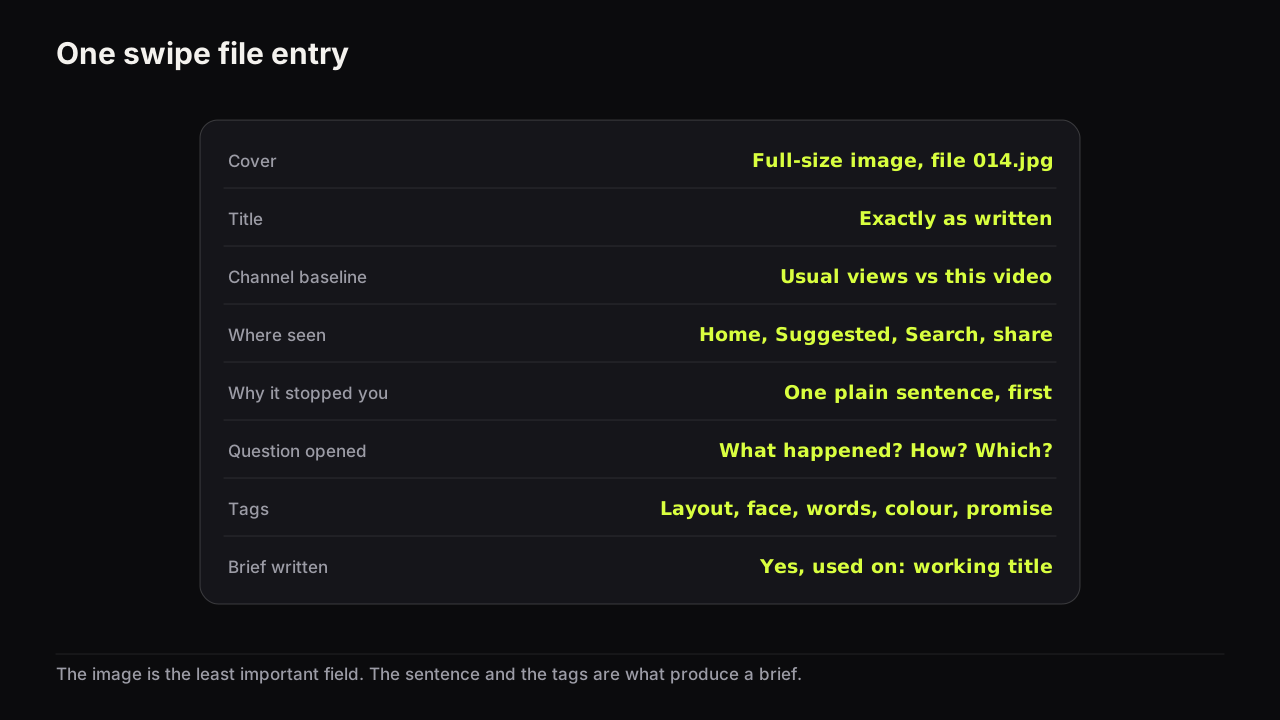
The instrument is the one the research method already gives you: tagged entries with dates, and tag counts for outliers against typicals. A swipe file built to produce briefs records the date seen and the upload date for every entry, and those two fields are what make the two signatures visible.
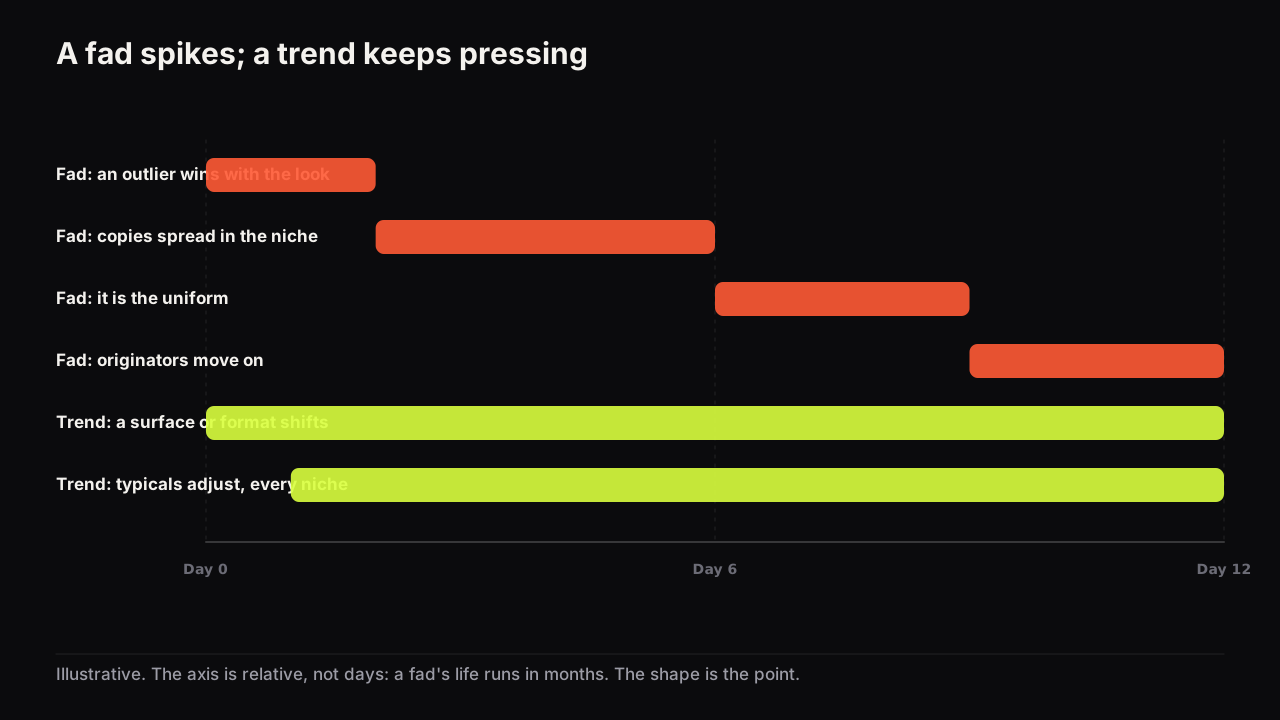
The fad signature. Sort the entries that carry a tag by upload date. A fad is a spike: the tag appears first in one or two outliers, spreads to your niche's typicals within a few months, is absent or rare in adjacent niches, and the earliest entries carrying it have stopped by the time the latest ones start. The tag count among typicals rises until it matches the count among outliers, at which point the outliers move on and the tag is no longer a difference between the two groups.
The trend signature. The same sort shows a slope rather than a spike. The tag rises slowly in the typicals of several niches at once, no first entry stands out as the origin, it never reverses, and you can name the external shift it coincides with. A trend rarely appears in the outlier count before the typical count, because it is not a way of winning; it is a way of fitting.
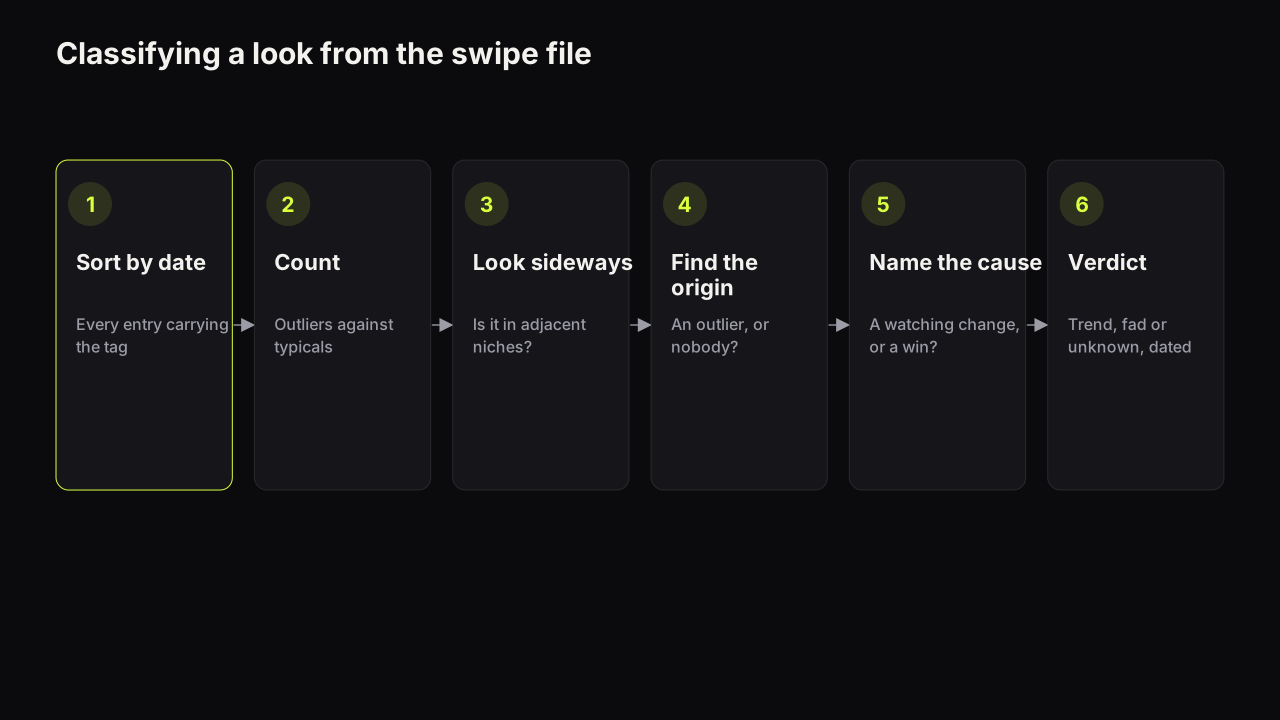
Five questions settle most cases.
- What caused it: a change in how people watch, or a cover that won?
- Who has it: typicals across several niches, or outliers and their imitators in yours?
- Is the originator still using it, and can you name one at all?
- Does it change what the cover does, or only how it looks?
- Would it still make sense if the outlier that started it had never existed?
Trend answers are: a watching change, typicals everywhere, no originator, a change in what the cover does, and yes. Fad answers are the opposites. A mixed set is the normal result, and the tie-breaker is the first question, because cause is the only one that predicts lifespan.
By the time creators outside the research habit notice something as "the trend", it is almost always a fad already in the typicals. Trends are rarely noticed as trends, because they arrive as a slow adjustment that nobody announces; the feed gradually asks for a bigger face, and the channels that respond do not feel they are following anything.
Adopt, adapt or ignore
The response follows from the classification and from where the look is in its life.
| Situation | Response | Why |
|---|---|---|
| A trend that changes how covers are seen (TV, a new grid, a new ratio) | Adopt the adjustment | The pressure is permanent, and lateness costs little |
| A trend in what the audience now expects a cover to include | Adopt the expectation, keep your fixed marks | Expectation fit is a lever; the look that carries it can still be yours |
| A fad, early: in outliers only, and it fits your promise | Adapt: take the mechanism, change the look | The value is in being early and different, not in the look |
| A fad already in your niche's typicals | Ignore, or go the other way | Joining now means joining the uniform |
| A fad that promises more than the video delivers | Ignore at any stage | A look that oversells is a packaging problem however many use it |
Adapting deserves a sentence, because it is the response most creators skip. A fad usually spreads because its first instance opened a question well: the arrow pointed at something worth seeing, the split put two things in tension. Take that mechanism, the question, and carry it with a different device, one step from the niche rather than a copy of it.
Imagine the look spreading in the home-workout row is a red circle around a dumbbell, an open-mouthed face, and "STOP DOING THIS" in yellow. Run the five questions: it traces to two outlier covers, it is in your niche's typicals and nowhere else, the originators have moved on, and it changes nothing about what the cover does. A fad, and a late one. The mechanism worth keeping is "one specific mistake, pointed at". The adapted cover: the dumbbell at half the height with the wrong grip plainly visible, a calm face looking at the hand, "YOUR GRIP" in white, no circle. The viewer infers a correction from someone who has seen the mistake, rather than an alarm from someone copying the row. How far to step outside the niche's look is the companion piece, and the fixed marks you keep while adapting are the ones consistency without sameness says to hold.
We recommend one rule for the undecided case: if you cannot tell which it is, wait until the tag appears in your niche's typicals, then look again. If it was a fad, you are now too late and have lost nothing by waiting. If it was a trend, it is still there and you are on time. A fad can only be copied too late; a trend can hardly be adopted too late.
The AI-sameness fad as the current example
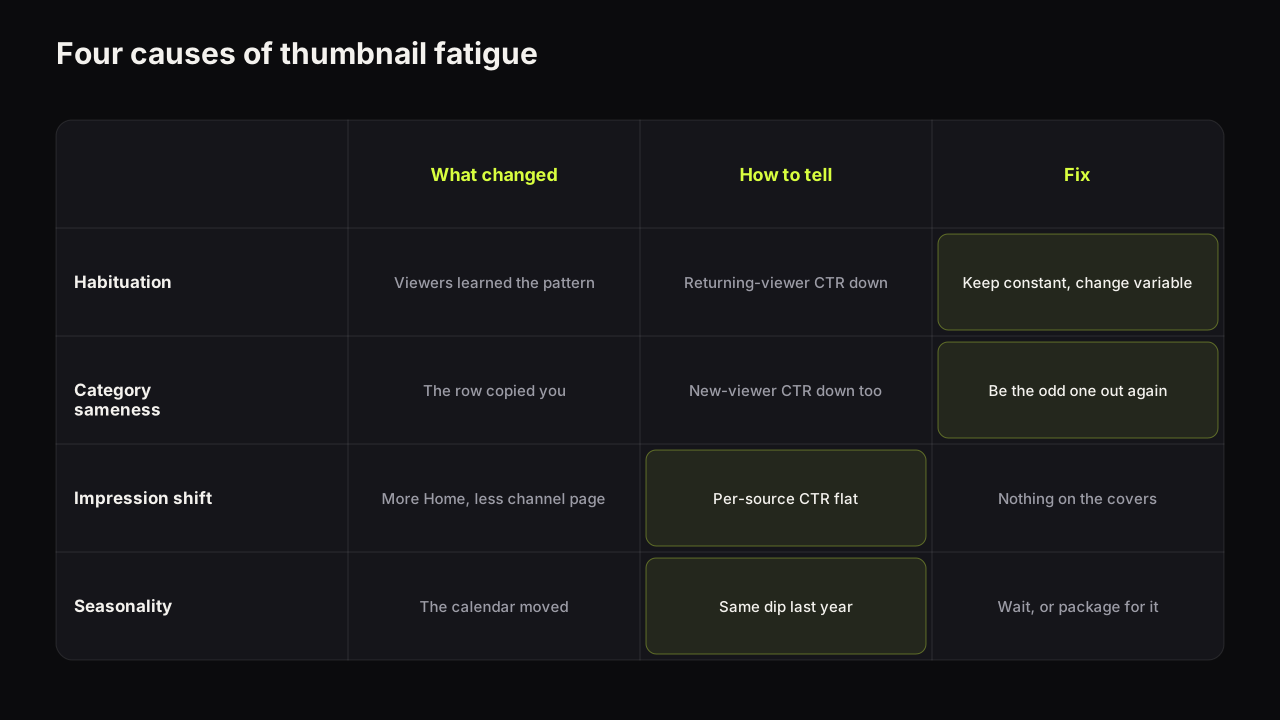
As of September 2026 the fastest-spreading look in most niches we look at is a generator's default: a centred subject, a glow behind the head, a warm-cool colour split, everything saturated. Run the five questions. The cause is a tool default, not a change in how anyone watches. It is in many niches at once, which looks like a trend, but nobody adopted it; they accepted it, and there is no originator because the same default arrived on every desk in the same month. It changes how covers look and nothing about what they do. The verdict is a fad with a trend's reach, and the response is the fourth row of the table: go the other way. The category-sameness section of the fatigue piece covers what that does to a niche's click-through rates, and the guide to AI generators covers how to override the defaults on purpose rather than by luck.
Keeping the classification alive
Add one column to the swipe file, trend, fad or unknown, and a revisit date three months out for every "unknown". On the monthly outlier pass, sort by that column. A fad you ignored that has reached the typicals is your cue to be the odd one out. A trend you adopted early is a check on whether the adjustment has made it into your house layouts or is still a one-off.
Explore is useful here for one narrow purpose: it is a gallery of covers made on the bench, filterable by niche, with no performance data, so it is not evidence of what is winning. What it offers is a way to try a layout you have classified as worth adapting, with your own face and headline through Remix, before committing a real upload to it.
What to do next
Pick the look that is spreading in your niche right now and run the five questions on it with your swipe file open. Write the verdict and the date in the new column. If it is a fad already in the typicals, plan the next cover to be the odd one out in the row. If it is a trend, put the adjustment into your house layouts, not into one cover. Then set the three-month revisit, because the verdict that matters is the second one.