On this page
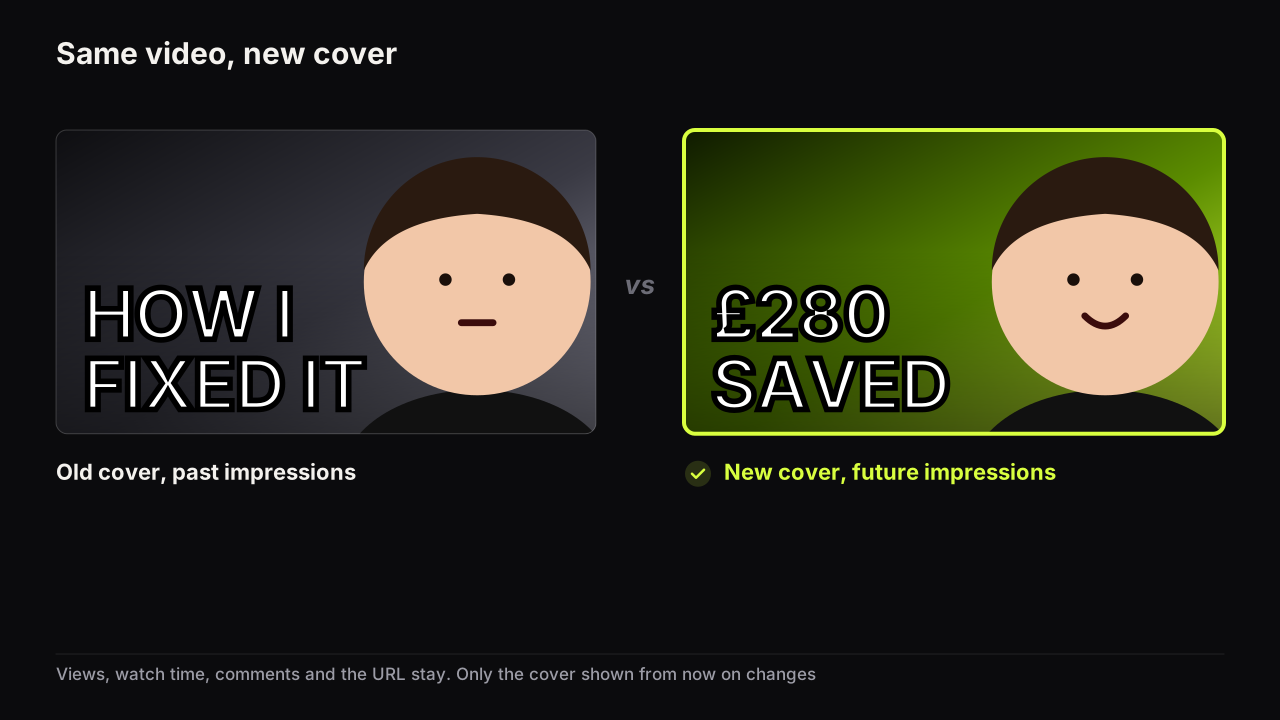
No. Changing a YouTube thumbnail does not reset the video's views, watch time, likes or comments, and it does not change the video's URL, because a thumbnail change is an edit to the video's details in YouTube Studio, not a new upload. What changes is the cover shown in the impressions that arrive after you save. So the only fair way to judge a new thumbnail is to compare click-through rate per traffic source before and after, on a video that is still being shown. None of the YouTube help pages we cite describes a penalty for changing a cover. The risk is the ordinary one: the new cover earns fewer clicks, or promises something the video does not keep.
What stays and what changes
This is how editing a video works, not a statistic. Replacing the thumbnail in YouTube Studio edits the details of an existing video, the same class of change as editing the description. The views, watch time, likes and comments belong to the video and stay with it, the URL and video ID do not change, and the analytics continue as one uninterrupted history. What changes is the image shown in impressions from that moment on.
Because nothing is lost, whether to change a cover is a question of judgement (will the new cover earn more clicks it can keep?) rather than a question of risk to the record.
Why the counters cannot reset
A view is counted against the video, and the video is the thing with the URL. The thumbnail is one of the video's details, alongside the title, description and end screen, and changing a detail does not create a new thing for views to attach to. That is also why a change cannot be undone by changing it back: the old cover returns, but the impressions served in between were served.
The same logic answers the version of the question that asks about "the algorithm". Nothing in YouTube's documentation on impressions and click-through rate or on testing describes a reset, a penalty or a re-evaluation triggered by a thumbnail change, and this library makes no claims about the recommendation system beyond what those pages say. What a new cover can do is change how often the video is clicked when it is shown, and that is the number to watch.
What does change: the cover in future impressions
The same help page says an impression is counted when the thumbnail is shown for more than one second with at least half of it visible, and the new cover only exists in impressions served after the change. Two things follow from that, and both catch people out.
A video that has stopped receiving impressions gets no benefit from a better cover until something shows it again. The numbers will not move. It is easy to conclude the new cover failed when it was never seen.
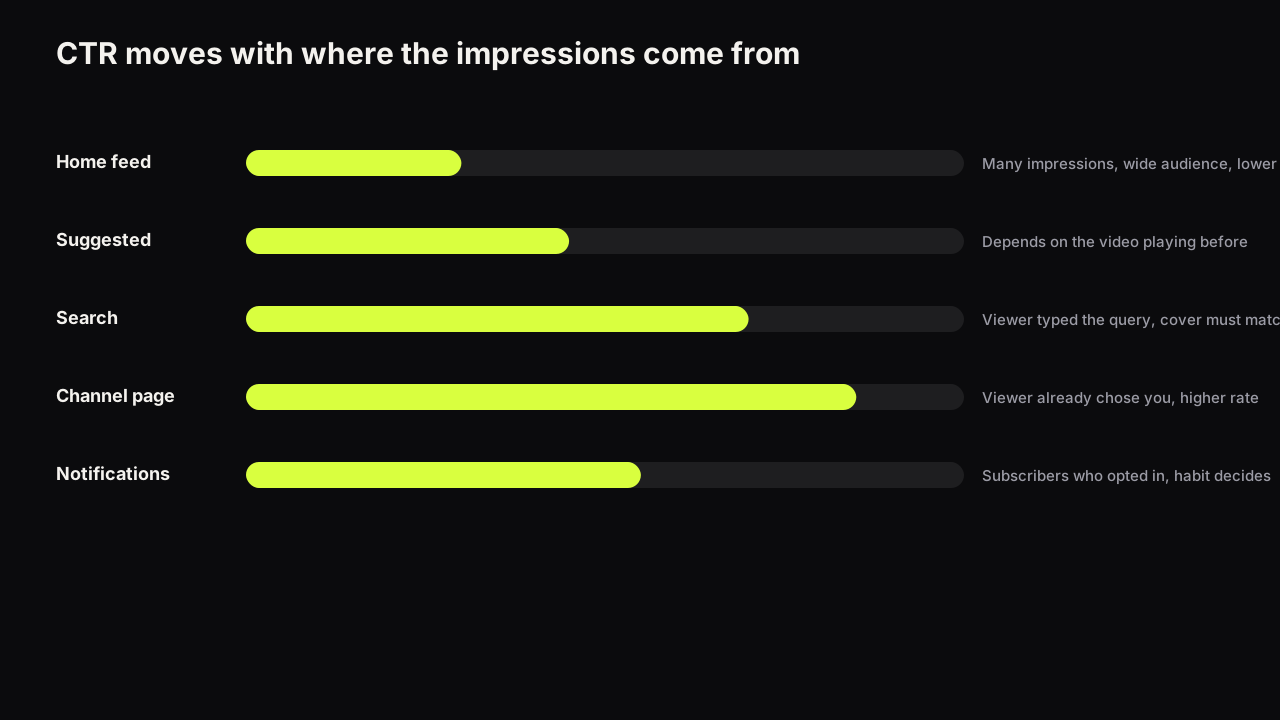
The blended CTR is the wrong number to compare. Take a hypothetical: a year-old bread video whose cover is a loaf on a board at a third of the height, the words NO KNEAD in cream on brown, nobody in frame. Say it runs at a blended 4%, mostly from Search. You swap in the loaf at half the height, torn open, your hands holding the two halves, the same two words in yellow. A week later the blended figure reads 3.5%, and it looks like a loss. Per source, Search went from 6% to 7% and Suggested held; what moved the average was Home, where impressions doubled that week, and YouTube's own page says a video shown a lot on Home will naturally have a lower rate. The cover won and the number fell. Those figures are invented to show the arithmetic, but the pattern is the ordinary one: a good CTR depends on where the impressions come from, so the comparison has to be per source.
One more thing, smaller. The change may take a while to show up on your own screen, because browsers and the YouTube app cache the old image; why a thumbnail can look unchanged after you replaced it covers the checks before you assume the upload failed.
How to judge the change fairly
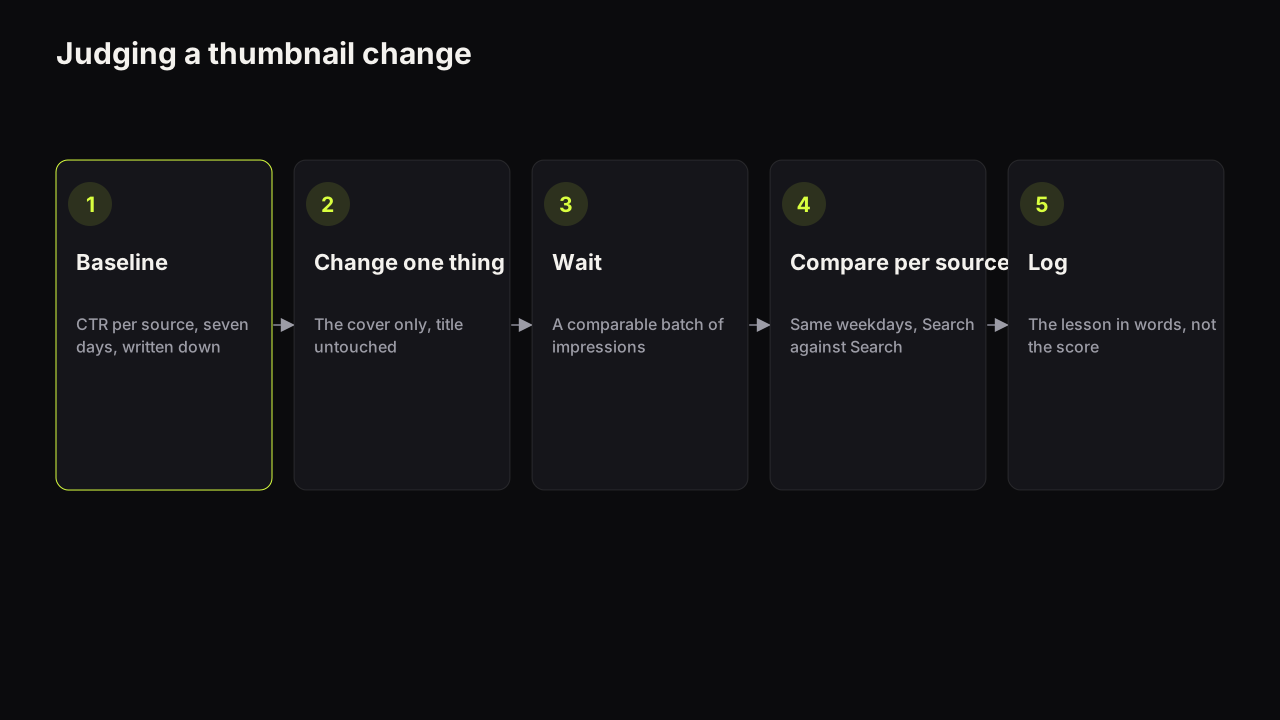
- Record the baseline first. Impressions and CTR per traffic source for the seven days before the change, written down.
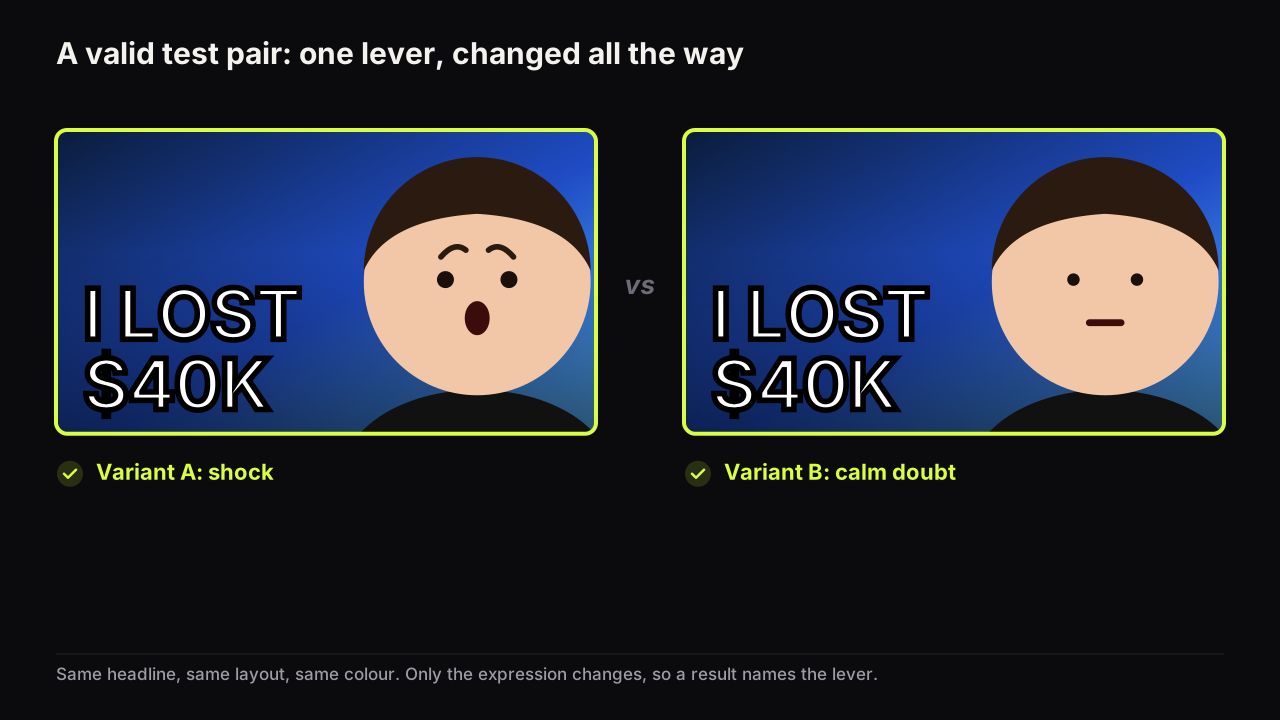
- Change one thing. The cover only. A title change in the same window turns a cover comparison into a packaging comparison.
- Wait for a comparable batch of impressions. A week is a reasonable default; how long a thumbnail test needs explains what makes it shorter or longer.
- Compare per source, on the same weekdays. Search against Search, Suggested against Suggested. If the impression mix shifted, the reasons a CTR falls for distribution reasons is the diagnosis to run before drawing any conclusion about the cover.
- Write down the lesson, not the score. "Calm beat shock on this tutorial" is reusable next week; "B won" is not.
We recommend treating any difference smaller than your channel's ordinary week-to-week wobble as no result. Look at how much CTR moves between two normal weeks on a video you did not touch; a swap has to clear that before it means anything.
Prefer Test & Compare where the video is eligible
A manual swap compares two different weeks. YouTube's own test compares two covers in the same week, on comparable audiences, which removes most of the noise a swap leaves in.
YouTube's help page on testing titles and thumbnails says Test & Compare in YouTube Studio can run up to three titles, thumbnails, or title and thumbnail combinations per video, that the result is decided by watch time share rather than clicks, that a test can take a few days or up to two weeks, and that the option with the highest watch time is shown to all viewers at the end. It runs on desktop, needs advanced features, and covers public long-form videos and podcast episodes, not Shorts.
Because the tool picks by watch time share, a new cover that earns more clicks from people who leave early loses, which is the tool measuring whether the new promise is kept; why the test can pick the thumbnail with fewer clicks explains the mechanism. Where a video qualifies, put the old cover and the new one into a test rather than swapping, using the method for running a test and reading its result; the old cover then serves as its own baseline.
When not to change it
Three situations argue for leaving the cover alone, and a fourth is a matter of temperament.
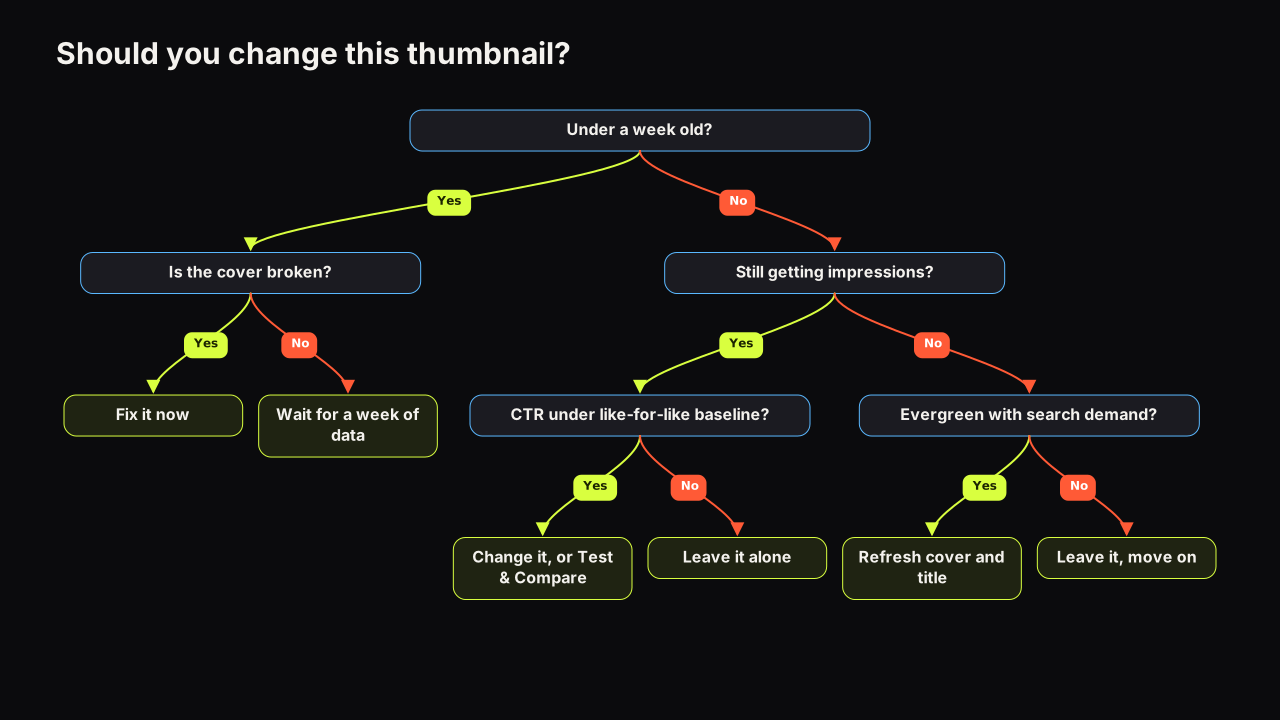
- The video is under a week old. YouTube's CTR page says new videos can show a wider range, and the impression mix is still settling. Unless the cover is broken (a typo, the wrong face, unreadable at phone size), wait.
- The video is at or above your like-for-like baseline. A cover earning its share of clicks does not need replacing because you are tired of it; the audience has seen it once.
- A test is running, or the title changed this week. Either one leaves you unable to say what moved the number.
The fourth is boredom. We would keep a cover that sits inside the baseline even when we have a design we like better, and even though that means the better idea waits in a drawer, because it is worth more on the next upload, where it gets a clean first week to be read against, than on a video whose audience has already met the old cover and moved on.
The full set of branches, including the evergreen case, is the decision tree for changing a thumbnail on a live video. If the real question is a catalogue of old covers, how to refresh old thumbnails in batches is the method, and on the bench the quickest route is to paste the video's own link into the maker, which grabs the current cover as the source so it can be rendered again with a new headline, a saved face and the channel's current style.
Common questions
Does changing the thumbnail reset the algorithm?
Nothing on the YouTube help pages this library relies on describes a reset, a penalty or a re-evaluation when a thumbnail changes. The video keeps its history and the new cover appears in future impressions. If the new cover earns more clicks that the video keeps, that is the whole effect.
How many times can I change a thumbnail?
The YouTube help pages on our verified list state no limit, and we do not claim one. The practical limit is measurement. Every change starts a new comparison window, so two changes in a week leave you unable to judge either. Change, wait a comparable window, compare per source, then decide again.
Does changing the thumbnail affect a running Test & Compare?
Let a test finish before touching the cover. A swap in the middle discards the comparison the tool was building, and the result state is the evidence you ran the test for.
What to do next
If the cover is broken, change it now; nothing is lost. If it is not, record the per-source CTR for the last week, change the cover only, wait a comparable window, and compare like with like. Where the video qualifies, run the old cover against the new one in Test & Compare instead, and write down the lesson either way.