On this page
Yes, update old YouTube thumbnails, but only the ones that can still be seen: videos that are still receiving impressions, or evergreen videos that search keeps finding, whose click-through rate sits under what comparable videos on your channel earn from the same sources. Everything else in the back catalogue can be left alone, because a better cover on a video nobody is shown changes nothing. Refreshing does not reset views, watch time or comments; it changes the cover in future impressions and nothing else. Below: the audit that finds the candidates, a batch method that keeps the result measurable, and the one published case everyone cites, with the caveats it needs.
Which old videos are worth a new cover
Rank the catalogue by how much a better cover could still change, which comes down to impressions still arriving and room to improve. Three signals, all in YouTube Studio, find the candidates in an hour.
| Signal | Where to look | What qualifies |
|---|---|---|
| Impressions still arriving | Reach data for the last month, videos sorted by impressions | Any old video near the top of the list |
| Search-led or evergreen | Traffic sources for that video: the share from Search and Suggested | A steady line rather than a spike that ended |
| CTR under the like-for-like baseline | CTR per traffic source against your comparable videos | Clearly under the middle of your own set, from the same source |
The first signal is the gate. A video with no impressions gets no benefit from a new cover until something (search, a playlist, a link from a new upload) shows it again, so the cover is not its constraint. The second signal separates videos whose demand continues from videos whose moment passed. The third says whether the cover is the suspect at all, and it only works if the comparison is like for like.
YouTube's help page on impressions and click-through rate says a video shown a lot on the Home page will naturally have a lower click-through rate, while videos whose impressions come mostly from the channel page may have a higher one, and that new videos or channels can see a wider range than the 2% to 10% band half of all channels and videos sit in.
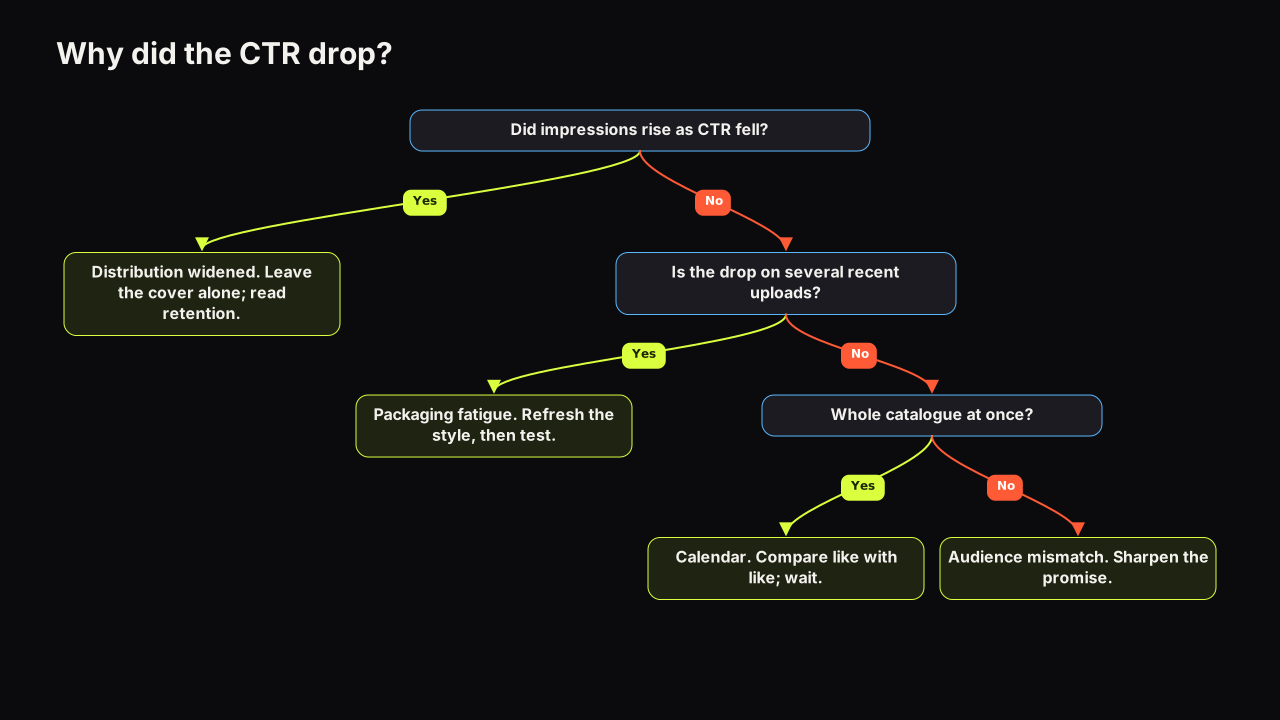
So an old video's blended CTR tells you little on its own. Compare its Search CTR with your other videos' Search CTR and its Suggested CTR with theirs; what impressions click-through rate measures and how to build a baseline is the method. A CTR that fell over the years while impressions grew is often distribution rather than decay, and the reasons a CTR can drop while the video is doing well should be run on the candidates before any of them is touched.
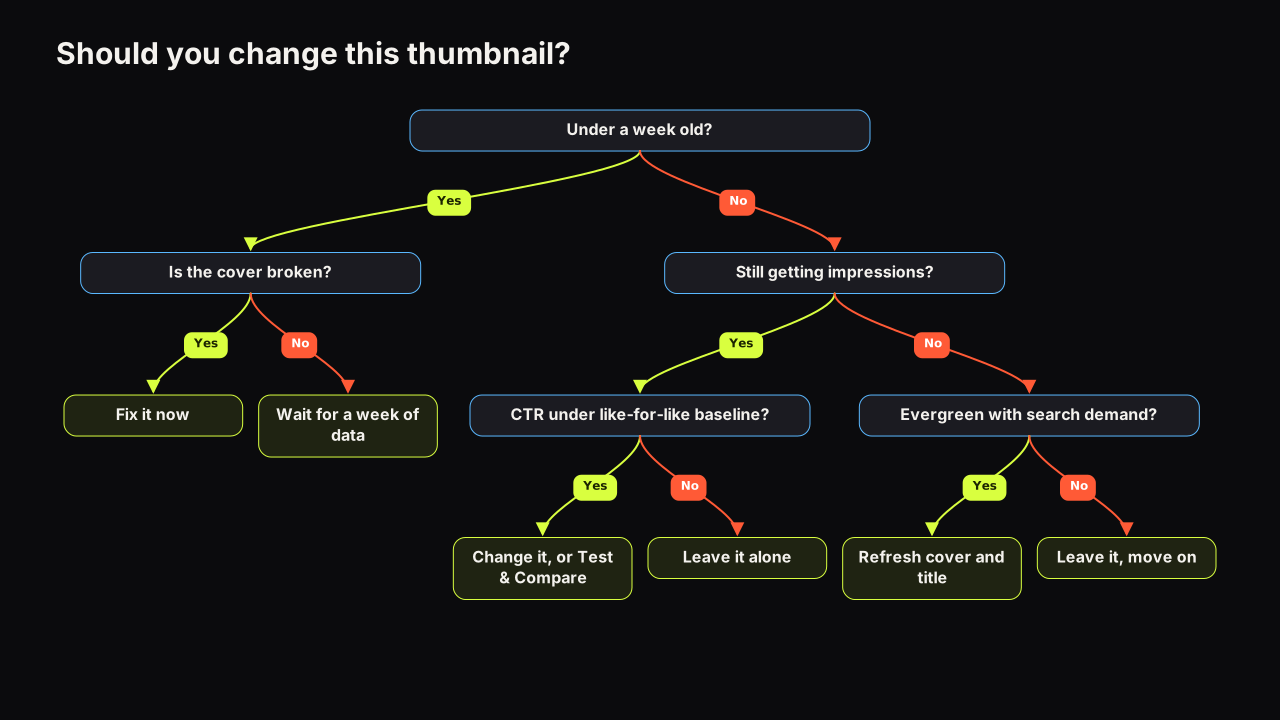
We recommend a shortlist of no more than ten videos from the first audit, ranked by impressions in the last month, containing only videos that clear all three signals. Ten is enough to learn from and few enough to measure one at a time. The full decision tree, including the first-week rule and the evergreen branch, is in the guide to when a thumbnail on a live video should change; this article assumes you have run it and are holding a list.
The Vevo case, and how much of it applies to you
The evidence usually quoted for refreshing old thumbnails comes from one catalogue, and it is worth knowing exactly what was reported.
Variety reported in 2019 that Vevo refreshed thumbnails across roughly 4,000 catalogue music videos and saw about a 12% average lift in views over the first 20 days after the change.
The caveats limit the claim. It was 2019, and the feed, the surfaces and the share of viewing on TV screens have all changed since. It was music video, a catalogue with continuing search and replay demand regardless of packaging, which is the best case for a refresh and not how a how-to or commentary channel behaves. And there was no control group, so some of the lift may be ordinary variation across a large catalogue over three weeks.
Our view is that Vevo shows one narrow thing: a systematic refresh of covers on a catalogue people are still looking for can move views, and the effect is visible within weeks. It says nothing about a channel whose old videos have stopped being shown, and nothing about what your gain would be. Treat it as permission to refresh in priority order and measure your own result, not as a forecast.
The batch method
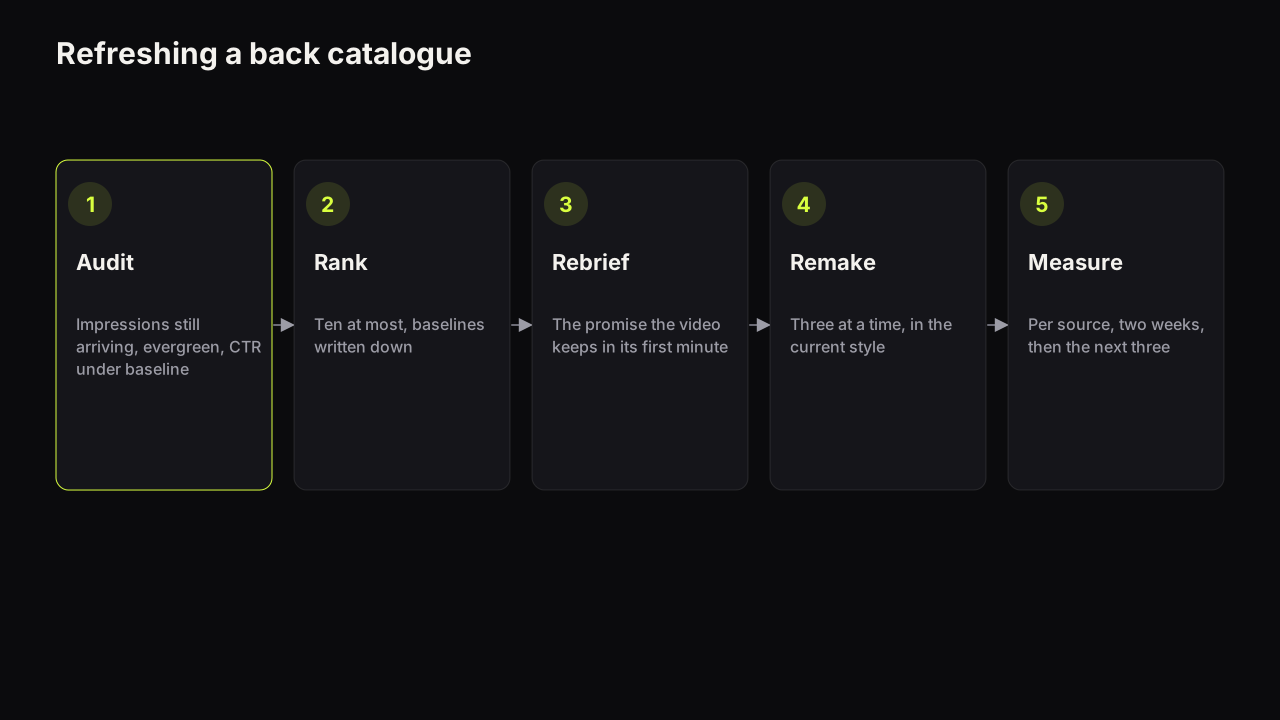
Refreshing a catalogue one video at a time, on impulse, produces covers with no baseline and no lesson. Refreshing in small batches with a measurement window between them produces both.
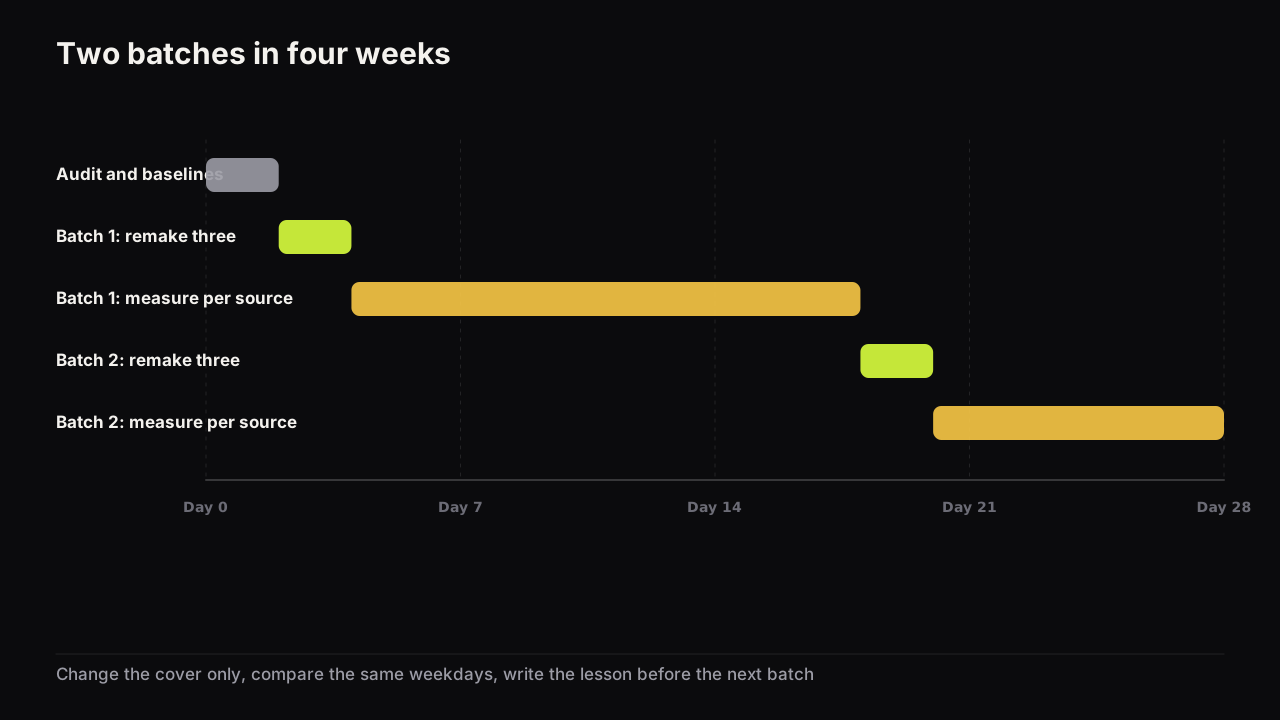
- Audit and rank. Run the three signals above and write the shortlist with each video's per-source CTR and impressions for the last month. The written baseline is the step people skip and the one that makes the rest measurable.
- Rebrief each video. Watch the first minute and write the packaging brief the video deserves now: the promise it keeps, the question the cover should open, the three words, the face and feeling, the object. Old covers often fail because they were made before the channel knew what its covers were for, so the brief is where most of the gain lives.
- Remake three, not ten. Take the top three from the list. Make the new cover, check it at thumb width beside the current row for that topic, and run the pre-upload checks on it. Change the cover only; leave the title unless the brief says the title is the problem too (see below).
- Wait a comparable window. Two weeks is a reasonable default for a search-led video, because impressions arrive slowly; compare per source, on the same days of the week, against the written baseline. Where a video is eligible, Test & Compare does the comparison for you, with the old cover as one of the variants, and is the better instrument because it measures both at once.
- Log, then take the next three. One line per video: what changed, what the per-source CTR did, and the lesson in words. After two batches the log usually says which lever the old covers were missing, and the third batch goes faster because the brief is already half written.
Keep the promise true to the video that exists
The most common mistake in a refresh is to package the video you would make today rather than the one that is there. A dated cover with a modest promise is replaced by a current-style cover with a bigger one, the clicks arrive, and the viewers leave in the first minute because the video does not do what the new cover says.
YouTube's thumbnails policy says thumbnails, titles and descriptions that promise content the video does not contain fall under the spam, deceptive practices and scams policy. Source: YouTube's thumbnails policy.
Short of policy, the test catches it: YouTube's tool picks by watch time share, so a refreshed cover that brings viewers who leave early loses to the old one. The rebrief step exists to prevent this. Watch the first minute, write down the moment that pays the promise, and package that moment. If the video's best moment sits deep inside it, the honest options are to package a smaller promise or to re-edit the opening, not to promise the deep moment on the cover.
The title is part of the same promise, and on an evergreen video the title is often the half that has aged worse, because the way people search for the topic has moved. When the brief says the title no longer matches the search, we would change both on the same day, even though that means we can never say which change moved the number, because a clean measurement of a video that is currently earning nothing is worth less than the views. Treating title and thumbnail as one promise is the frame.
Refresh with the current style, not a new one per video
A back catalogue is also where the channel's look either becomes consistent or becomes a museum. The refreshed covers should look like the channel's current uploads, so a viewer who arrives from an old video sees a channel rather than an archive.
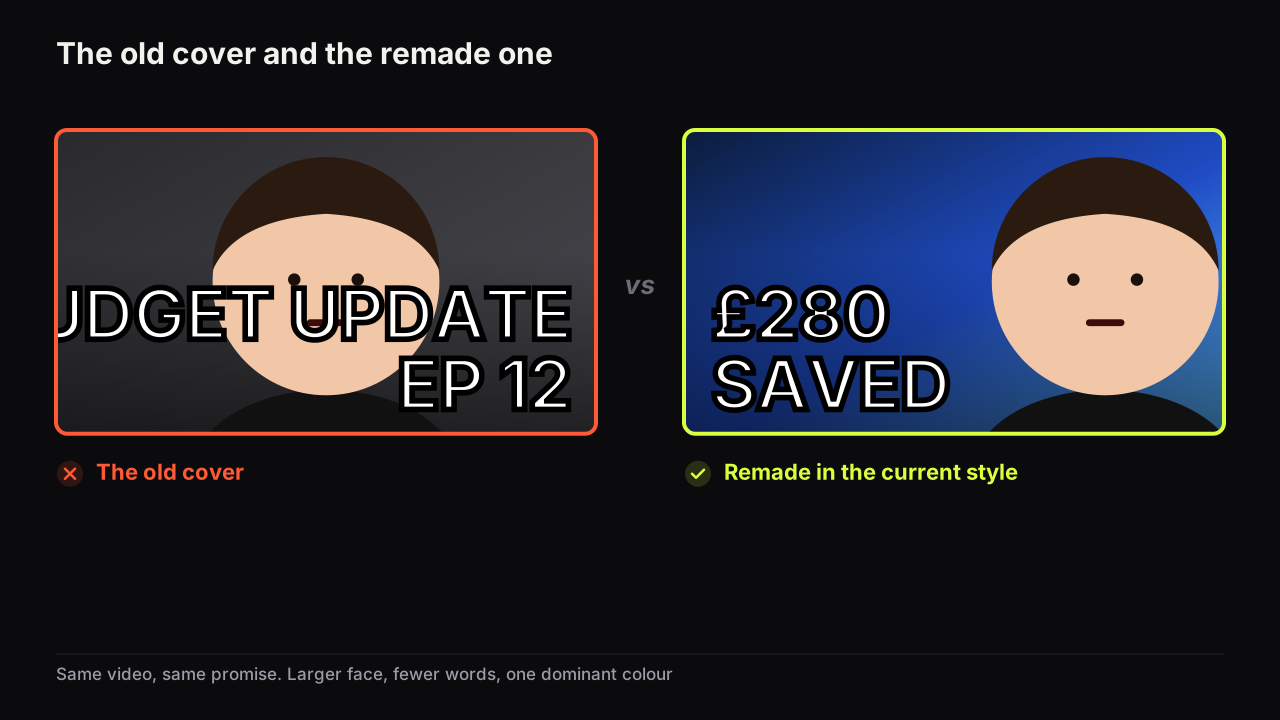
Take an old how-to on fixing a dripping tap, four years up, still drawing search impressions, and imagine its cover: a wide photo of the whole sink, the creator small at the edge, a caption in thin white type reading "How to fix a dripping tap at home (easy DIY)" along the bottom, grey on grey. At feed size the viewer reads nothing and infers a low-effort upload. The rebrief says the promise is still true and the payoff, the worn washer coming out, is at minute two. The remake: the tap filling the left half with a drop caught mid-fall, the creator's calm face at a third of the height on the right, NO PLUMBER in white with a dark outline, and the channel's current dark blue ground. Same video, same promise, and nothing on the new cover the video does not show.
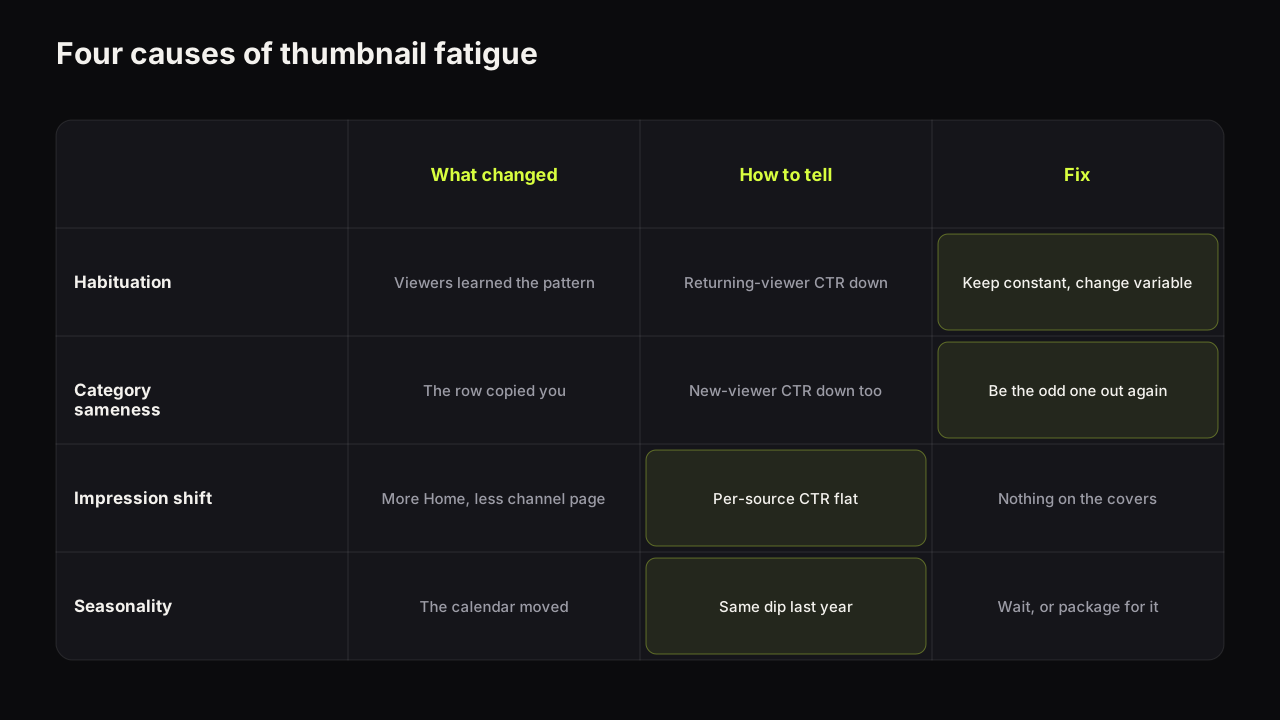
Before the first batch, look at the low-CTR group as a set. If the same layout, expression or colour keeps appearing on the underperformers, the problem is a style rather than a video, and the refresh is the moment to fix the style once; how to tell whether a style died or the distribution changed is the diagnosis. Look at the current row for each topic too, because the neighbours have changed since the old cover was made: studying the covers that now win in your niche tells you which colour and layout makes the refreshed cover the odd one out this year rather than the year it was made.
The fastest way to do the work is to remake your own old cover rather than start from a blank canvas. On the bench, paste the video's YouTube link into the maker and it grabs that video's thumbnail as the source, so the old cover can be rendered again with the new headline, a saved face and one of the current styles; the layout that worked stays and everything dated goes. Remaking your own past covers is what the paste-a-link route is for.
What not to do
- Do not change ten covers on the same afternoon. Nothing is lost, but nothing is measured either, and the log will say "changed everything, something happened".
- Do not refresh topical videos. A reaction to news from two years ago has no demand for a cover to convert. Leave it and spend the hour on an evergreen video.
- Do not change a cover while a test is running, and do not change the cover in the same week you changed the title unless you have decided to give up attribution on purpose.
- Do not judge the change in the first days. Search-led impressions arrive slowly and the numbers wobble; wait for a comparable batch of impressions and compare per source.
- Do not assume the upload failed when the old cover is still showing. Apps and browsers cache the old image for a while; why a thumbnail can look unchanged after you replaced it covers the checks. And if you are worried the change costs the video anything, what a thumbnail change does and does not reset is the short answer: nothing the video has earned.
What to do next
Run the audit this week and write the shortlist with baselines. Rebrief the top three, remake them in the channel's current style, and put the strongest into a test where the video is eligible. Wait two weeks, compare per source, log the lesson, and take the next three. The refresh then becomes a monthly habit at the end of the five-step thumbnail workflow, where the runner-up from each new upload is already waiting as the next refresh candidate.
The one niche with a documented refresh case of its own is music; music and artist channel thumbnails covers what that case does and does not show.